Home Blog Page 135

We organise 42nd Omolayole Mgt. Lecture to move Nigeria into top 20 global economies with $1trn GDP — Organisers

0

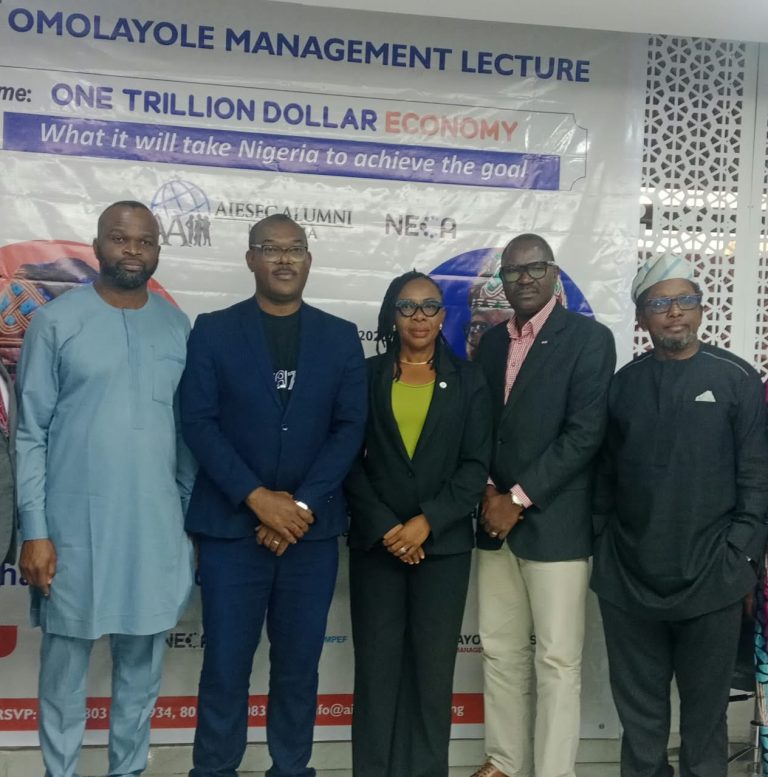
L-R President, AIESEC Alumni, Mr. Marcel Nba, Mr. Thompson Akpabio, Director Legal Regulatory and Taxation NECA, Chidinma Obiejesi, Vice president CIPM, Mr Abayomi Folarin, Director, membership service and Chairman Organizing Committee, Engr, Bayo Ige at a press conference held at NECA in preparation of Omolayole Management Lecture.

BY TAIWO OGUNMOLA-OMILANI


Organisers of the 42nd Omolayole Management Lecture, in partnership with the Nigeria Employers’ Consultative Association (NECA), have said the initiative is aimed at contributing to Nigeria’s aspiration to join the world’s top 20 economies with a $1 trillion Gross Domestic Product (GDP).

The lecture, themed “One Trillion Dollar Economy: What It Will Take Nigeria to Achieve the Goal,” will hold on September 24, 2026, at NECA House, Alausa, Lagos.

The event is expected to bring together business leaders, policymakers, professionals, academics and other stakeholders to examine practical measures for achieving the target.

Speaking at a press conference on Thursday, the NECA Director-General, Mr Adewale Smart-Oyerinde, represented by the Director of Legal, Regulatory and Taxation, Mr Thompson Akpabio, said the lecture would provide an avenue for stakeholders to deliberate on issues affecting Nigeria’s economic growth, businesses and workplaces.

Akpabio said the media remained an important partner in communicating issues that shape the economy, workplace and future of enterprise in Nigeria.

He said the Omolayole Management Lecture had, over the past 42 years, provided a platform for discussing issues of national importance and generating recommendations that had been communicated to the Federal Government.

According to him, the 2026 edition is coming at a time when Nigerian businesses are facing rapid technological changes, evolving workplace expectations, skills gaps, competitiveness challenges and the need to improve productivity and resilience.

The Chairman of the Organising Committee, Engr. Bayo Ige, said the choice of the theme was informed by concerns over Nigeria’s economic position and the need to stimulate discussions on how the country could achieve sustained growth.

Ige noted that South Africa currently had the largest economy in Africa, with a GDP of about $479 billion, while Nigeria’s GDP stood at around $377 billion, stressing that the country needed to reverse economic setbacks and pursue stronger growth.
He said, “We want to move Nigeria to the top 20, and this discourse is part of the actions that will take us there.”

Ige explained that the organisers selected Mr Adetunji Adetokunbo Oyebanji as the lead speaker because of his more than 40 years of leadership experience across Africa, Europe and North America.

Oyebanji is the immediate past Managing Director and Chief Executive Officer of 11 Plc and is also the President of the Chartered Institute of Directors.

Ige described him as a “leader of leaders,” saying his experience across different industries would bring valuable perspectives to the discussion on leadership and economic development.

Also speaking on why the theme was chosen, the President of AIESEC Alumni, Mr Marcel Nba, said that out of more than 195 countries in the world, only about 21 currently have economies worth more than $1 trillion in nominal GDP.

Nba said Taiwan, with a GDP of about $976.72 billion, ranked 22nd, adding that none of the countries with a $1 trillion economy was in Africa.

He said South Africa’s GDP was about $479.96 billion, while Nigeria’s stood at approximately $377.37 billion.
“Sadly, Nigeria had achieved a higher GDP level in the past. So, it is a source of concern and interest to all discerning citizens of Nigeria,” he said.

Nba urged stakeholders to join the conversation at the lecture scheduled for September 24.

The Omolayole Management Lecture is an annual management and economic development event held in honour of veteran industrialist and former Chairman/Chief Executive Officer of Lever Brothers (Unilever Nigeria), Dr Michael Omolayole.

The lecture was established in 1985 by AIESEC Alumni Nigeria to address contemporary socio-economic issues of national and international concern.

The 42nd edition is expected to focus on the policies, leadership, management practices, investments and institutional reforms required to support Nigeria’s aspiration for a $1 trillion economy.
2027: Duke’s presidential ambition attracts international media spotlight

0

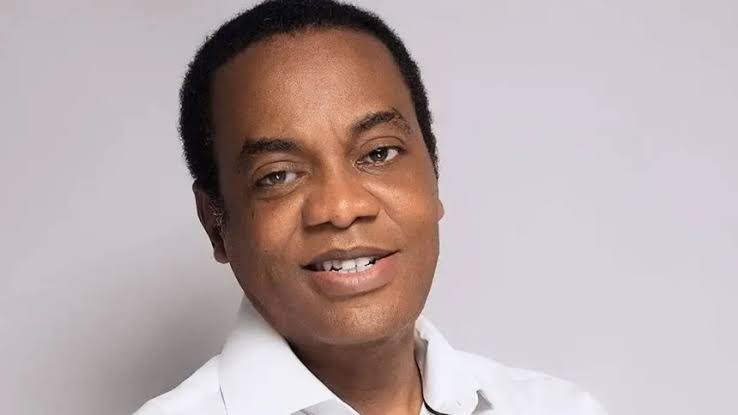
People’s Redemption Party (PRP) presidential candidate, Donald Duke, has attracted international media attention ahead of Nigeria’s 2027 general election, with an Indonesian publication spotlighting his candidacy and reform agenda.

Global Hukum Indonesia, in reports on the former Cross River State governor’s presidential bid, presented Duke as one of Nigeria’s promising presidential contenders of the past two decades and highlighted his proposals on economic reform, education, technology and Artificial Intelligence.
The publication said Duke was attracting attention from international political and economic observers as campaigns for the January 16, 2027 presidential election gather momentum.

It stated that media organisations and observers in the United States, Europe and Asia, including Washington, Brussels, China, Malaysia and Indonesia, were monitoring developments around his campaign.

The publication highlighted Duke’s vision and record in government, presenting them as indicators of the approach he intends to bring to national governance.

It said: “In response to Nigeria’s economic and governance challenges, Duke is committed to far-reaching structural reforms aimed at building a fair, transparent and corruption-free government.

“Combating corruption in government institutions is central to Duke’s strategy to restore the confidence of domestic and international investors, reduce poverty, improve public welfare and position Nigeria as a leading economic powerhouse on the African continent.”

Duke, who governed Cross River State between 1999 and 2007 following Nigeria’s return to democratic rule, is one of the 18 presidential candidates on the final list released by the Independent National Electoral Commission (INEC).

He was elected governor on the platform of the Peoples Democratic Party (PDP) in 1999 and re-elected in 2003. He later contested the 2019 presidential election on the platform of the Social Democratic Party (SDP).

For the 2027 election, Duke is flying the flag of the PRP.

Global Hukum Indonesia also highlighted his education programme, saying his campaign regards education as both a right and a fundamental obligation.

According to the publication, Duke’s programme envisages modernising Nigeria’s basic and higher education systems to expand access to quality education and give young Nigerians greater opportunities to compete globally.

It also drew attention to Duke’s proposed national Artificial Intelligence strategy, designed to harness emerging technology for governance and economic development.

Under the proposal, AI tools would be deployed in public administration to streamline government operations, improve public services, enhance transparency and strengthen digital systems for combating corruption.

The strategy also envisages deploying AI and other technologies to accelerate transformation in agriculture, manufacturing, financial technology and other strategic sectors, alongside a nationwide digital literacy programme.

The publication said the programme would extend the use of modern technology and AI to public infrastructure, healthcare and public safety.

It presented Duke’s approach as combining an international outlook with domestic governance experience and said his programme could provide a framework for addressing Nigeria’s economic and technological challenges as the country heads towards the 2027 presidential election.

Military confirms rescue of 31 kidnap victims in Katsina, Kebbi

0

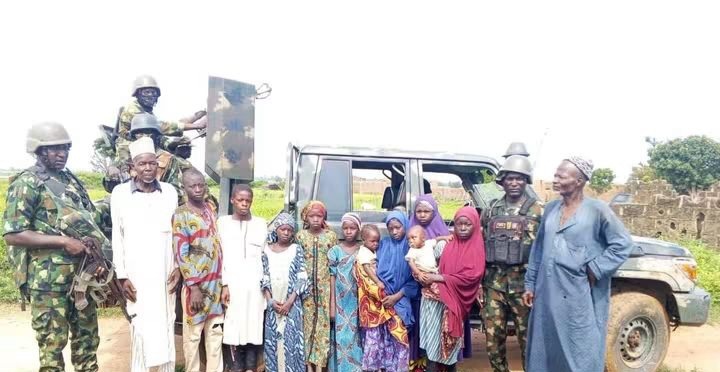
Troops of the Joint Task Force (North West), Operation Fansan Yamma, have rescued 31 kidnapped victims, neutralised two terrorists and arrested two suspected terrorists in separate operations in Katsina and Kebbi States on September 14 and 15.

Media Information Officer, Joint Task Force (North West), Operation Fansan Yamma, Lieutenant Colonel Aliyu Danja disclosed this in a Wednesday statement.

Danja stated that on September 14 in Katsina State, troops of Sector 2, following reports of the abduction of civilians from Unguwan Daudu and Unguwan Chibauna communities in Funtua Local Government Area, swiftly mobilised to intercept the terrorists.
He said troops launched a hot pursuit and engaged the terrorists in a gun battle, leading to the rescue of 10 kidnapped victims comprising three males and seven females including an infant.

The rescued victims are in troops’ custody for further action.

Similarly on September 14 in Kebbi State, troops of Sector 2 responded to a distress call following the abduction of civilians from Fafala Village in Kangiwa Local Government Area.

Acting on credible intelligence, troops conducted a fighting patrol towards Fafala and Dandikwa where they made contact with the terrorists and engaged them in a heavy exchange of fire forcing the terrorists to withdraw in disarray.

Danja said subsequent exploitation led to the rescue of 21 kidnapped victims who were successfully reunited with their families.

The military spokesman further stated that on September 15 in Katsina State, troops of Sector 2 acting on credible intelligence regarding plans by terrorists to attack communities within Matazu and Kankara Local Government Areas mobilised towards the identified hideout.

Troops made contact with the terrorists and engaged them with superior firepower, neutralising two terrorists including Abbah Alhassan, a known terrorist kingpin.

Other terrorists reportedly fled into the surrounding bush.

Danja said exploitation of the area led to the recovery of 10 rounds of ammunition, one motorcycle, one cutlass, camouflage clothing and Indian hemp among other items.

Also on September 15, troops of Sector 2 arrested two suspected terrorists in the Yantumaki general area of Dan Musa Local Government Area, Katsina State.

Danja said preliminary interrogation revealed that the suspects were associated with a terrorist kingpin known as Mannori.

The suspects have been taken into custody for further investigation.

Danja said the successes recorded underscore the continued efforts of Operation Fansan Yamma to rescue victims, disrupt terrorist networks, and deny terrorists freedom of action across the Joint Operations Area.

“The Joint Task Force appreciates members of the public for their continued support and urges them to remain vigilant and promptly report suspicious activities to the nearest security agency,” the statement further reads.

Tinapa: I didn’t abandon resort, I sustained it until I left office — Imoke

0

Former Cross River State Governor, Senator Liyel Imoke, has rejected claims that his administration abandoned the Tinapa Business and Leisure Resort, insisting that he sustained the project until he left office.

Imoke said his administration continued to invest in and expand the use of the ₦40 billion resort, while also introducing additional facilities and activities to keep it operational.

The former governor made the clarification during an exclusive interview with ARISE NEWS on Wednesday while responding to criticisms from his predecessor, Donald Duke, over the state of Tinapa.

Duke, who initiated the Tinapa project, had accused Imoke of abandoning the resort after taking over as governor.

However, Imoke disputed the claim, saying his administration inherited the project and continued to support it despite the financial and infrastructural challenges surrounding its operations.

“There was no half-road built, and there was no abandonment. I kept it going and sustained it until I left office,” Imoke said.

According to him, his administration also sought to maximise the use of the resort by connecting facilities and hosting major government and public events there.

He said Duke had begun plans for a monorail before leaving office and that he subsequently connected the project to the Tinapa Convention Centre.

“I connected that monorail to the Convention Centre. I brought an ICT hub into Tinapa. I moved aspects of the Calabar Carnival and festival to Tinapa,” he said.

Imoke added that his administration used the resort for government conferences and other major gatherings, including South-South governors’ meetings, economic development conferences and events organised by the Nigerian Society of Engineers.

He maintained that these measures were part of his broader effort to ensure continuity in governance and derive value from projects funded with public resources.

The former governor, however, argued that Tinapa’s challenges were rooted largely in its original conception and the absence of the wider commercial ecosystem required to make the resort viable.

“Let us start with the concept of Tinapa—it was badly conceived at the beginning. That is the reality,” he said.

Imoke explained that Tinapa was initially conceived as a free trade shopping destination, but the necessary regulatory, commercial and economic conditions were not established alongside its construction.

He said the state was left with substantial infrastructure inside the resort without sufficient supporting infrastructure outside it.

“The commercial environment for Tinapa to succeed was not in place, and the economic environment was also not in place,” he said.

According to Imoke, the project’s viability depended on factors such as adequate air connectivity, a dredged seaport, suitable free trade zone regulations, tax incentives and road infrastructure, many of which were outside the control of the state government.

He said the situation placed significant financial pressure on Cross River, particularly because the state had to continue funding the resort while the conditions required for its commercial success remained unresolved.

Imoke also disputed the suggestion that he neglected other tourism assets inherited from Duke, particularly the Obudu Ranch Resort.

He said his administration maintained the resort’s cable car for eight years despite the high cost of operation, while also taking steps to improve access and safety.

According to him, the cable car cost about $40 million to construct, while annual maintenance expenses at the time were about ₦240 million.

He said revenue from the cable car covered only about eight per cent of its maintenance cost, yet his administration continued to keep it operational.

Imoke also said his government brought Sun International/Protea to manage the Ranch, provided subsidised electricity and flights, acquired a Dash 8 aircraft for passenger services and installed a DVOR navigation system to improve the safety of flights to the area.

He said these interventions were necessary because poor access had affected occupancy at the resort.

Reflecting on his administration’s broader record, Imoke said continuity was central to his approach to governance.

He cited the expansion of Duke’s urban renewal programme from Calabar Municipality to Calabar South, the extension of street lighting beyond Marian Road, and the continuation and expansion of the Calabar Carnival.

“Government was continuous, and we sustained every single project, added value to every project, and increased the outcomes of everything that he himself had started,” he said.

Imoke said public office should not be used to abandon projects simply because they were initiated by a predecessor, arguing that elected officials have a responsibility to protect public investments and serve the wider interests of citizens.

“If anyone is in office and doesn’t understand the importance of continuity and the usage of public funds, it’s not a place to go and express your ego,” he said.

The former governor maintained that his administration’s priority was to balance the continuation of major projects such as Tinapa and Obudu with its broader responsibilities to Cross River residents, including healthcare, education, rural development, infrastructure and payment of civil servants.

Alausa: FG out to rescue Unity Schools from decay, PTAs criminal enterprise

0

* Says King’s College, Unity Schools are dungeon of stench, darkness

Amid protests over the concession of King’s College, Lagos, to its Old Boys’ Association, Minister of Education, Dr. Tunji Alausa, has defended the Federal Government’s decision, painting a grim picture of a school system he said had degenerated into dungeons of stench, darkness and decay unfit for training Nigeria’s future leaders.

Alausa, who spoke when he received a management team of The Sun Publishing Limited, led by its Managing Director/Editor-in-Chief, Onuoha Ukeh, said conditions at King’s College and some other Federal Unity Colleges had deteriorated to unacceptable levels and required urgent intervention.


Recalling a visit to King’s College about a year ago, the minister said he was moved to tears by what he saw — filthy hostels and classrooms, unusable bathrooms, inadequate infrastructure and prolonged power outage.

“The hostels reeked of stench. Bathrooms were unclean. Dormitories looked like dungeons. The cafeteria resembled a place where slaves were fed. The school had no electricity for nine months,” Alausa said.

According to him, conditions in the classrooms and laboratories were equally disturbing.

“Classrooms had heaps of garbage. The science laboratory was in darkness. Students could not see the writing on the board. I asked a teacher how learning was possible in such conditions. The teacher had no answer,” he said.

Alausa said the experience, coupled with reports from other Unity Schools, convinced him that urgent action was required to halt the deterioration.

The Federal Government’s decision to concession the management of the 117-year-old King’s College to the King’s College Old Boys’ Association (KCOBA) under a Public-Private Partnership arrangement has triggered protests by workers and parents and disrupted activities in Federal Unity Colleges. The government has maintained that the school has neither been sold nor privatised and that it retains ownership and regulatory oversight.

Alausa said consultations with the Old Boys’ Association resulted in an arrangement under which the alumni would deploy their resources to rehabilitate, modernise and manage the institution.

“The King’s College Old Boys’ Association has offered to step in, take over management of the institution and invest its own resources into its full restoration.

“The alumni have pledged that the arrangement will involve no fee increases and that the school will continue admitting pupils from all regions of Nigeria,” he said.

The minister insisted that the arrangement did not amount to privatisation, saying the Federal Government would retain ownership while the interests of workers would be protected.

“About 57 of the 120 academic staff are Federal Government employees, while the rest are PTA staff. Everyone will be accommodated,” he said.

Alausa also questioned whether the Unity School system could continue to operate exactly as originally conceived, arguing that the circumstances that informed its establishment decades ago had changed considerably.

“Decades ago, parents could safely send their children to schools in distant states, but modern security concerns have rendered that practice impossible. Consequently, while private schools are expanding rapidly, government-owned Unity Schools continue to suffer from decades of severe neglect,” he said.

The minister expressed concern over opposition from some Parent-Teacher Associations (PTAs) to the reform programme, alleging that some had become involved in practices requiring investigation.

He alleged that some PTAs sell admission slots for as much as N20 million at a time some teachers earn about N60,000 monthly.

“In Unity Schools, pupils are left unsupervised, and some are involved in drug abuse,” he alleged.

Alausa further claimed that some PTAs had engaged a Senior Advocate of Nigeria (SAN), whose legal fees ranged between N100 million and N150 million, to challenge the reform.

“Where does a PTA get such money if not from criminal enterprises? Some of these groups even hire protesters to block reforms,” he alleged.

The minister said the Federal Government lacked the resources to undertake at once the extensive rehabilitation required across the Unity Schools, estimating that even N1 trillion would be inadequate to address the infrastructure deficit nationwide.

According to him, rehabilitating Unity Schools in Lagos alone would require about N24 billion, while those across the South-West would need nearly N40 billion.

Given the financial constraints, Alausa said partnerships with willing alumni associations offered a practical way of mobilising additional resources to restore deteriorating institutions.

He added that although the management model was being introduced at King’s College, it could eventually be extended to other Unity Schools, depending on the outcome of the arrangement and the willingness of alumni associations to support the rehabilitation of their former schools.

Beyond the controversy over King’s College, the minister said the government was recording progress under the Nigeria Education Sector Renewal Initiative, anchored on six pillars — technical and vocational education, Science, Technology, Engineering and Mathematics (STEM), reintegration of out-of-school children, expansion of girl-child education, data integration and digitalisation, and quality assurance.

He said more than one million out-of-school children had returned to classrooms, while over 250,000 young Nigerians were receiving training across 1,200 skills centres, with Federal Technical Colleges offering free tuition.

Alausa said enrolment in nursing education had risen from about 28,000 to approximately 130,000, while medical school intake increased from 5,000 to 12,000.

Under the World Bank-supported AGILE programme, he said more than six million girls had been enrolled in school.

The minister also said Nigeria had developed what he described as Africa’s largest education database, enabling the government to track children from primary through senior secondary education.

He said the data had, however, exposed a major problem in the transition from primary to secondary education, with between 22 million and 28 million children at primary level dropping to about 12 million at junior secondary level.

“This 18-million-child deficit is primarily caused by a severe shortage of secondary school facilities. Across the country, there are approximately 78,000 public primary schools but only 18,000 junior secondary schools,” he said.

Alausa said state and local governments, which he said receive 62 per cent of net federal revenues, also had a responsibility to expand secondary education infrastructure.

He urged journalists to interrogate the available education data and hold subnational governments accountable for deficiencies in school infrastructure.

Nigerian Woman Charged in US for Alleged Illegal Voting

0

A 56-year-old Nigerian woman, Gladys Adaeze Okafor, has been arrested and charged with allegedly voting illegally in the 2022 midterm elections in the United States after falsely claiming to be a U.S. citizen.

The United States Attorney, Leah B. Foley, and Jeff Grimming, Acting Special Agent in Charge of Homeland Security Investigations in New England, announced the charges in a statement issued by the U.S. Department of Justice on Wednesday, September 16, 2026.

Okafor, who resides in Lynn, Massachusetts, is also alleged to have voted in the 2024 presidential primary election.

She was charged with unlawfully voting as an alien and was arrested on Wednesday morning. She is expected to appear in federal court in Boston later the same day.

According to the charging documents, Okafor is a Nigerian citizen who was born in Aba, Abia State.

She obtained lawful permanent resident status in December 2022 but is not a U.S. citizen and has not applied for U.S. citizenship.

In July 2022, Okafor allegedly submitted a voter registration form, signing her name under a certification stating, “I AM A CITIZEN OF THE UNITED STATES … Signed under penalty of perjury.”
The City of Lynn subsequently registered her to vote, and Okafor allegedly voted in the 2022 midterm elections.

The charging documents further allege that Okafor submitted a second voter registration form in October 2023, checked the “U.S. Citizen” box and signed the certification for U.S. citizens. She allegedly voted in the 2024 presidential primary election.

The charge of unlawful voting as an alien carries a maximum sentence of one year in prison, one year of supervised release and a fine of up to $100,000.

The defendant may also be subject to deportation upon completion of any sentence imposed.

Sentences are imposed by a federal district court judge based on the U.S. Sentencing Guidelines and statutes governing sentencing in criminal cases.

Assistant U.S. Attorney Julissa Walsh of the Major Crimes Unit is prosecuting the case.

King’s College: Why we backed ₦100bn concession deal — Olumide Akpata

0

A member of the King’s College Old Boys’ Association (KCOBA) and former Nigerian Bar Association president, Olumide Akpata, has explained why the association backed the concession of King’s College, Lagos, insisting that the arrangement is aimed at restoring the 117-year-old institution rather than acquiring it.

Akpata made the clarification during an interview on Arise News amid opposition from some parents, students, unions and other stakeholders to the Federal Government’s concession agreement with KCOBA.

The Federal Government has also clarified that the concession does not amount to a sale or privatisation of King’s College, saying legal ownership remains with the government while KCOBA is responsible for financing, rehabilitating, modernising, operating and maintaining the school under the agreement.

“King’s College has not been sold. We have not bought the school, the school has not been offered to us, and we are not interested in buying our school,” Akpata said.

He described the institution as the “Alma Mater” of its old students, saying the association could not stand by while the school deteriorated.

Akpata said KCOB’s planned ₦100 billion investment would be deployed to upgrade infrastructure, improve maintenance and enhance the learning experience for students.

The association launched a ₦100 billion Collegium Endowment Fund in July to support infrastructure renewal, teacher development, digital technology, scholarships, innovation, research and student welfare.

According to Akpata, KCOBA has already invested billions of naira in the school over the years, including renovating buildings, upgrading sports facilities, installing generators, establishing an ICT laboratory and providing a library equipped with Braille facilities for visually impaired students.

“We have renovated every building standing in that school at one point in time or another. We have redone the sports pitch, put tartan tracks, put drainage under the football pitch,” he said.

“What have we not done? We have put generators in that school, an ICT lab, and a library for the blind students where Braille and other equipment have been provided.”

He said the challenge was that facilities often deteriorated after the association’s interventions because of inadequate maintenance.

Akpata explained that the concession was therefore intended to formalise KCOBA’s longstanding support for the institution and give the association a structured framework to raise and deploy funds for its development.

“So when we went to government, we said, ‘We know you have a lot on your plate. We are ready to help. We have been helping, and we have demonstrated capacity. Going forward, can we formalize this engagement?’” he said.

“We are going to raise money to make sure that we upgrade infrastructure. We are going to raise money to make sure that the learning experience of our boys will be top-notch, world-class.”

Addressing concerns raised by teachers, parents and other stakeholders, Akpata said he understood the reservations but maintained that the door remained open for further discussions.

He said the Federal Ministry of Education had engaged with unions during the process and that KCOBA was willing to meet with stakeholders to explain the objectives of the concession.
“We are ready to continue the conversation. We are ready to talk to the stakeholders so that they can hear from us,” he said.

The concerns have included the effect of the arrangement on admissions, school fees, staff and the public character of the institution. Parents and students staged a protest in August against the concession and threatened legal action.

The Federal Government has subsequently stated that King’s College remains a public national institution and that admissions will continue under applicable Unity College policies, including principles of merit, transparency, fairness and national representation.

On allegations of admission racketeering and excessive levies at the school, Akpata said he had not personally witnessed such practices but acknowledged that he had heard reports about them.

“I cannot put hand to heart and tell you that I have witnessed anything of the sort, but we have heard these stories so many times,” he said.

According to him, the concession is expected to address such alleged “leakages” and improve accountability within the school.

“These are the leakages that we intend to block,” Akpata said.

Akpata said KCOBA expected visible improvements within three years, while stressing that the association would be bound by the terms of the concession agreement.

“It is a marathon, not a sprint, but we are committed,” he said.

He noted that the agreement contains provisions relating to inclusivity, access and fees, adding that KCOBA could face consequences if it failed to comply with its obligations.

“I think in the next couple of years—in three years maximum—you will begin to see a turnaround,” he said.

The Federal Government has said the concession agreement contains performance indicators, infrastructure standards, reporting requirements, audits and inspection mechanisms, while retaining oversight and corrective powers.

Akpata also rejected the suggestion that the arrangement was driven by commercial interests, insisting that KCOBA’s objective was to restore the institution to the standards envisioned by its founders.

“There is no profit motive here; it is all altruistic. We want to look after our mother,” he said.

“We want to make sure that the products of King’s College are those that were envisaged by the founding fathers: leaders who will continue to steer the ship of our nation ahead.”


Abuja-based lawyer exposes new traffic scam

0

An Abuja-based lawyer, Usman A. Lanase Esq., has raised the alarm over a new traffic offence scam targeting motorists in the nation’s capital.

In a Wednesday statement shared on X, the legal practitioner said he received a text message while on his way to the office from the Federal High Court informing him of a new road traffic offence.

Lanase said he was surprised because he did not breach any traffic lights and no official of the Federal Road Safety Corps (FRSC) stopped him.

He said he clicked the link in the message to confirm the alleged offence and was told he exceeded the speed limit on a public highway at 92km/h.
According to him, the penalty for the alleged offence was stipulated to be N5,000, which he decided to pay until he dug further and found out it was all a scam.

“I was shocked because how? Me? 92KM/h? As how? I told myself, no problem, it’s just 5K. But this is not enough for me to accept that I violated any traffic rule. I did not overspeed at any time, so I need FRSC to prove to me that I am indeed liable,” Lanase said.

He added that he decided to wait before taking any further step, only to later see posts on X where other Nigerians described the message as a new scam tactic.

“Thank God my lawyerly mind saved me. Innocent Nigerians have been defrauded. I hope FRSC works with the EFCC to uncover the identity of these criminals defrauding innocent Nigerians,” he said.

Sun

We’re raising ₦100 billion. Stay with us for better welfare, or stay with the civil service and be posted elsewhere.”

0


Kings College Old Boys promise to double teachers’ salaries and not increase school fees as parents and teachers protest the concession of King’s College, Lagos.

The immediate past President of the Old Boys and Secretary of its Board of Trustees, Dr. Leke Oshunniyi responds to some of the biggest concerns on this episode of Corridor Chat.

#Kings College

credit: Nifemi

PRESIDENT TINUBU MOURNS VETERAN ACTOR OLU JACOBS AT 84

0


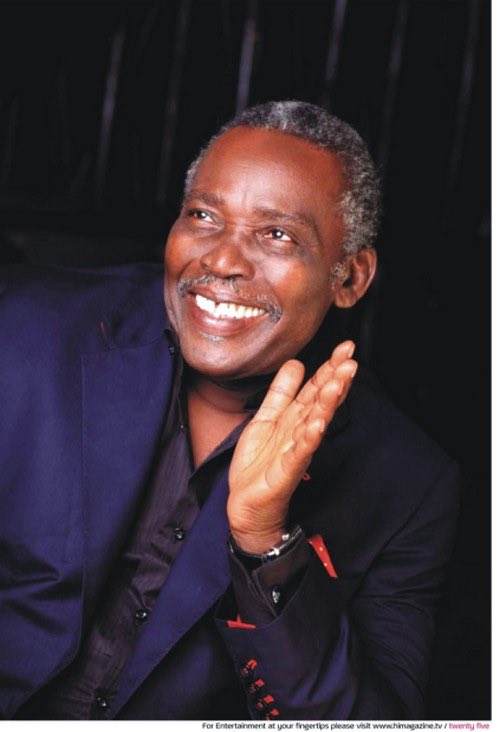
President Bola Ahmed Tinubu has expressed sadness over the passing of veteran Nollywood actor and film executive Oludotun Baiyewu Jacobs, popularly known as Olu Jacobs, who passed away at age 84 on Tuesday.

After his training at London’s Royal Academy of Dramatic Arts, Olu Jacobs built a career in British television and international film before returning home to Nigeria, where he became a major force in the film industry.

He won major industry honours and awards for his pioneering roles and was also conferred with the national award of Member of the Order of the Federal Republic (MFR).

President Tinubu described the late Olu Jacobs as one of Nigeria’s most distinguished actors and a towering figure whose remarkable career spanned theatre, television and film globally.

The President acknowledged his contributions to the development and professionalisation of Nigeria’s entertainment industry, stating that the late Jacobs inspired generations of actors and filmmakers through his exceptional talent, discipline and dedication to his craft.

President Tinubu also praised the late actor’s remarkable ability to bring depth, dignity, and authenticity to the characters he portrayed, earning him admiration in Nigeria and beyond.

“He was a giant of the Nigerian creative industry. His passing is a great loss to Nigeria, the African film industry and the global community of lovers of the performing arts. His remarkable body of work will continue to speak to generations yet unborn.

“The nation recognises the enormous contributions of Nigeria’s creative practitioners to the country’s cultural identity, global image and economic development. Olu Jacobs played a big role in creating this identity,” the President says.

The President extended his heartfelt condolences to the Jacobs family, particularly his wife, veteran actress Chief Joke Silva, their children, relatives, colleagues in the Nigerian film industry and the entire creative community over the loss of the celebrated thespian.

He prayed for the repose of his soul.

Bayo Onanuga
Special Adviser to the President
(Information & Strategy)