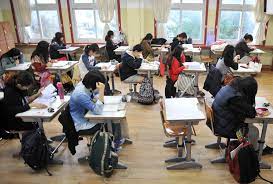
The total number of students in kindergartens and elementary, middle and high schools in South Korea has fallen below six million for the first time, government data showed on Thursday.
According to data from the Ministry of Education, there were 5,957,087 students enrolled in kindergartens and elementary, middle and high schools nation wide as of April 1, marking a decline of 0.9 per cent from a year earlier.
Student population decreased on all levels of schools, excluding middle schools, which increased 2.7 per cent to 1.35 million.
The number of students dropped 4.9 per cent to 582,572 at kindergartens, 0.8 per cent to 2,672,340 at elementary schools and 2.8 per cent to 1,299,965 at high schools.
South Korea has been struggling with a steady decline in childbirths.
Last year, the number of newborns hit a record low of 272,300, down 30,300, or 10 per cent, from the previous year, according to separate government data.
Notably, the number of elementary and secondary school students from multicultural families rose 8.6 per cent on-year to 160,056 this year, the data found, marking a continuous annual increase since 2012.
As a result, the ratio of multicultural students in all enrollments at elementary and secondary schools edged up 0.2 percentage points to 3 per cent.
Meanwhile, the number of students enrolled in higher education institutions in South Korea decreased 2.3 per cent to 3.2 million this year.
The number of students decreased 2.2 per cent to 1.94 million at general universities and colleges, 1.4 per cent to 15,409 at teachers colleges and 7.4 per cent to 576,041 at junior colleges.
But the number of graduate students increased by 2.1 per cent from last year to 327,415.
The number of foreign students registered in higher education institutions here fell 0.9 per cent to 152,281.
The number of international students in the degree programmes increased by 6.2 per cent to 120,018, while the number in the non-degree programmes decreased by 20.7 per cent to 32,263.
Among all international students, Chinese students accounted for the largest share at 44.2 per cent, or 67,348, which marked an increase of 0.6 percentage point from last year.
Then Vietnamese students accounted for 23.5 per cent of the total, or 35,843.