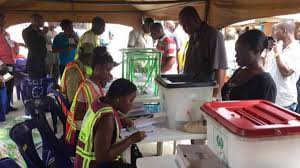
…. says mock exercise had no real parties or candidates, any claim of a winner is baseless
The Independent National Electoral Commission (INEC) has disowned a website, neis.ng, which is publishing purported results of the mock accreditation and election conducted on Saturday, and claiming that a named presidential candidate is leading.
In a statement issued on Sunday in Abuja and signed by Adedayo Oketola, Chief Press Secretary / Media Adviser to the INEC Chairman, the Commission said the website is not affiliated with, authorised by or connected to INEC in any way.
“The Commission wishes to state categorically that the website is not affiliated with, authorised by or connected to INEC in any way, and that the figures it displays are false and misleading.”
No Real Parties, No Real Candidates
INEC stressed that the mock exercise did not feature real political parties or candidates.
“The mock exercise did not feature real political parties or candidates. It used pseudo names generated solely for the dummy ballot papers, which Nigerians saw during the exercise. The exercise was designed to test the Commission’s technology, processes and logistics, not to produce results for any candidate.”
INEC Chairman, Prof. Joash Amupitan, had made the same clarification before the exercise, saying the ballot papers to be used are pseudo-ballot papers and not containing the name of the registered political parties.
The mock exercise held on Saturday, November 28, 2026, from 8:30 a.m. to 2:30 p.m. in two polling units per ward nationwide — 17,676 polling units across 8,838 Registration Areas — to test upgraded BVAS devices, logistics, and the INEC Result Viewing Portal (IReV).
“Any Claim Of A Winner Is Baseless”
“Any claim that a candidate or party won, led or trailed in the mock exercise is therefore baseless, and any website or platform presenting such figures as mock election results is deceiving the public.”
The warning followed figures circulating on the NEIS platform which showed the presidential candidate of the Nigeria Democratic Congress (NDC), Peter Obi, leading with 5,775,102 simulated votes, representing 31.5 per cent, while President Bola Tinubu came second with 5,612,075 votes, and former Vice-President Atiku Abubakar third with 5,471,831 votes.
The APC Presidential Campaign Council has also rejected the figures, describing them as fictitious and fraudulent. Its spokesperson, Dele Alake, said INEC declared no winner or loser, and questioned how NEIS arrived at figures for parties when ballot papers used options such as AQUA, BLUE, COAL, CYAN and GOLD, not party names or logos.
NEIS itself had earlier clarified on X on November 26 that its exercise was designed to test its infrastructure and system engines, was not an endorsement of any candidate, and was independent of INEC’s mock accreditation exercise.
INEC: Use Only Official Channels
INEC urged Nigerians, political parties, candidates and the media to disregard the content of http://neis.ng and similar platforms, and not to share it.
“INEC will continue to publish only verified information through its official channels, including http://inecnigeria.org, and its verified social media handles.”
The Commission said it is reviewing the matter and reserves the right to take appropriate action against those responsible for spreading false election information.