BY TAIWO OGUNMOLA -OMILANI
The Ogun State Government has assured manufacturers of ongoing reforms to harmonise taxes, tackle illegal levies and decentralise electricity generation to reduce production costs and improve the business environment.
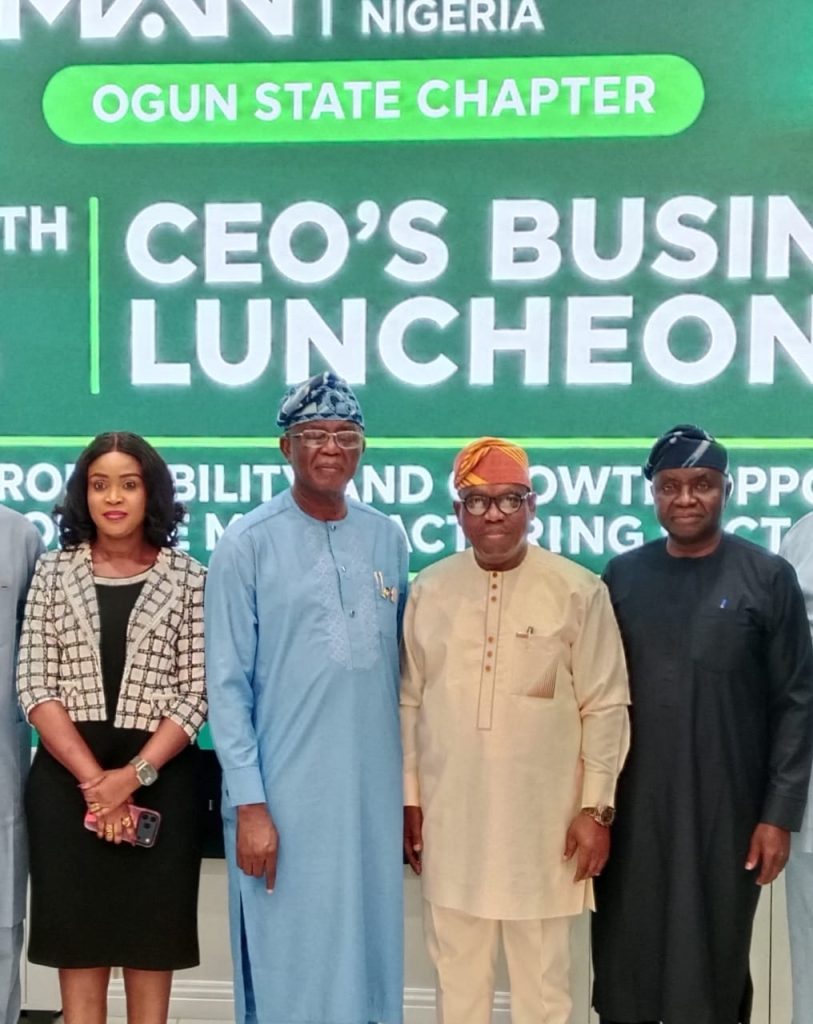
The Commissioner for Industry, Trade and Investment, Mr. Adebola Sofela, who was represented by Mr. Yemisi Folarin, gave the assurance on behalf of Governor Dapo Abiodun at the 12th Chief Executive Officers’ (CEOs) Business Luncheon of the Manufacturers Association of Nigeria (MAN), Ogun State Chapter.
The event, held at the headquarters of Coleman Wires and Cables in Arepo, Ogun State, had as its theme, “Profitability and Growth Opportunities for the Manufacturing Sector in 2027.”
Delivering the keynote address, the Chief Executive Officer of the Centre for the Promotion of Private Enterprise (CPPE), Dr. Muda Yusuf, called for a constitutional or fiscal review to extend the derivation principle to states hosting manufacturing industries.
Yusuf proposed that Ogun State and other industrial hubs should receive at least five per cent of the Company Income Tax (CIT) generated by factories operating within their territories.
He explained that host states provide critical infrastructure, including roads, drainage, water supply and waste management, as well as social services such as schools and hospitals for factory workers, while also bearing the environmental impact of industrial activities.
He noted that their direct revenue from manufacturing activities was largely limited to Pay-As-You-Earn (PAYE) tax, which he described as often insignificant.
According to him, extending the derivation principle to industrial states would promote equity, arguing that “what is good for the oil-producing states is good for the host states of Nigeria’s industries.”
On the economic outlook for 2027, Yusuf projected gradual recovery, with Nigeria’s Gross Domestic Product (GDP) growth expected to range between 4.0 and 4.5 per cent.
He identified declining inflation, improved foreign exchange stability and liquidity, lower financing costs and increased public investment in infrastructure as factors that could support manufacturing growth.
However, he cautioned manufacturers against global risks, including geopolitical tensions and commodity price volatility, while urging them to explore opportunities in regional trade and supply-chain diversification.
Speaking at the event, the President of MAN, Dr. Ifeanyi Okoye, commended Nigerian manufacturers for sustaining employment and production despite high energy costs, interest rates, weak consumer demand and regulatory uncertainties.
While acknowledging the Federal Government’s launch of the Nigerian Industrial Policy 2025, Okoye stressed that the success of the policy would depend on its implementation.
He urged the Ogun State Government to focus on the operational challenges confronting existing factories rather than measuring industrial progress solely through investment announcements.
According to him, the competitiveness of an industrial destination should also be assessed through infrastructure quality, regulatory consistency, employment sustainability and manufacturers’ ability to compete in wider markets.
He added that recent national tax reforms presented an opportunity to address multiple taxation and overlapping charges affecting businesses.
In his welcome address, the Chairman of MAN, Ogun State Chapter, Mr. Martins Awofisayo, described the theme of the luncheon as a call to action for government, regulators and industrialists.
He identified high energy costs and limited access to affordable long-term financing as major challenges affecting the competitiveness of locally manufactured goods.
Awofisayo said the ultimate measure of government reforms should be their impact on production costs, investment, employment and competitiveness.
Speaking in an interview after the event, Awofisayo described the 12th CEOs’ Business Luncheon as timely and necessary, noting that it was organised to equip chief executives with strategies to address anticipated challenges in 2027 and improve profitability.
He explained that profitability remained the foundation of business sustainability, adding that the gathering provided an opportunity for manufacturers to exchange ideas and explore ways of sustaining their operations.
On electricity supply in Ogun State, the MAN chairman acknowledged the state government’s efforts to improve power generation but said the current arrangements had yet to meet manufacturers’ expectations.
He disclosed that the state government had scheduled a seminar for December 16 to discuss ways of increasing electricity generation, particularly through renewable energy.
He also cited ongoing and proposed power projects in Ota and along the Ijebu-Ode axis as part of efforts to address the challenge.
Awofisayo, however, stressed that electricity remained one of the biggest components of manufacturers’ production costs, citing independent power providers charging as much as 16 cents per kilowatt-hour.
He disclosed that some MAN members paid between N40 million and N100 million monthly for electricity, describing the expenditure as a major burden on their operations.
He said the planned engagement with the state government would provide an opportunity for manufacturers to discuss practical solutions to the electricity challenge.
Reaffirming the state’s commitment to industrial development, the Commissioner for Environment, Mr. Oladimeji Oresanya, said Governor Abiodun had put frameworks in place to create an enabling environment for businesses.
He also urged Nigerians to patronise locally manufactured products, noting that the state government was committed to promoting local patronage to stimulate industrial growth.
Similarly, the Special Adviser to the Governor on Ogun Invest, Mrs. Sola Arobieke, pledged the agency’s readiness to collaborate with manufacturers to address operational challenges and facilitate business expansion in the State.