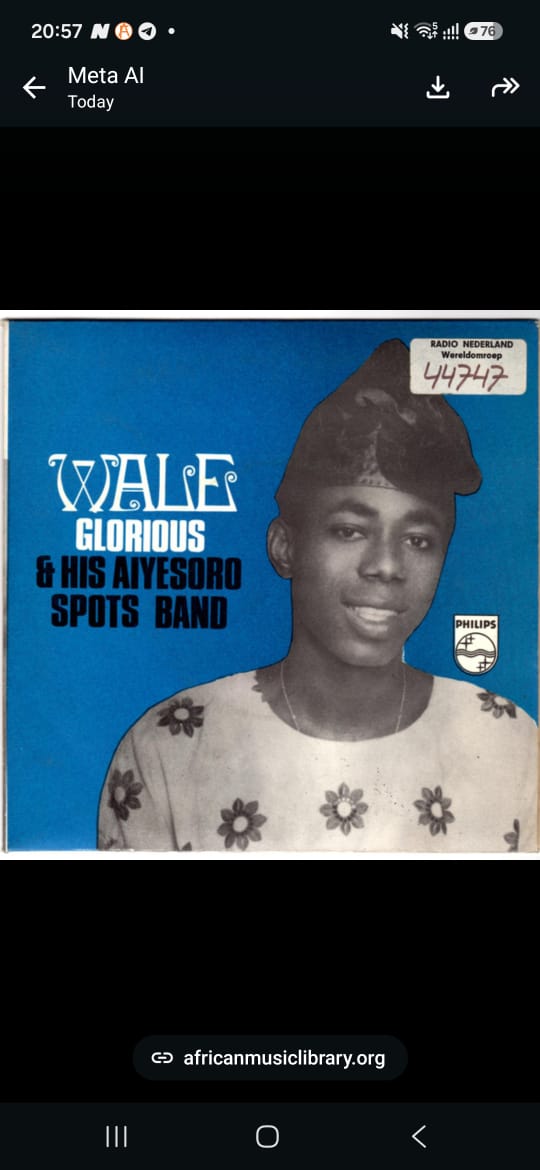
55 Years After, Akure Still Mourns The Star Who Died At 29
By
Hakeem Jamiu
The memory of Wale Glorious (1942-1971), the Akure-born Juju legend and leader of Wale Glorious and his Aiyesoro Spots Band, who gave Akure its anthem, “Awa L’Akure Oloyemekun” still lingers. There are musicians who live long, record many songs, grow old, and are gradually forgotten. And there are musicians who live for a very short time, yet their names refuse to die. Wale Glorious belongs to the second group.
Fifty-five years after his death on November 16, 1971, his name still echoes in Akure, the Ondo State capital. His song, “Awa L’Akure Oloyemekun,” is still played at weddings, at cultural festivals, at town gatherings, and at moments when Akure people want to remind themselves of who they are. It has become the unofficial anthem of Akure Kingdom. How does a man who died at 29, who lived before the age of social media, before the age of television hype, before the age of music streaming, achieve such immortality? That is the mystery and the magic of Wale Glorious.
In a recent emotional online interview, Pastor Dapo Modupe, one of those who witnessed his era closely, gave a vivid account of the life, the fame, the character and the painful death of this unusual legend. His testimony brings back to life a man many of today’s generation never saw, but whose music they still feel. Wale grew up in the town that would later become the capital of Ondo State, and he grew up loving music.
In the 1960s, when he came to prominence, Juju music was already a big force in Western Nigeria. The field was crowded with great names like Kayode Ige, I.K. Dairo, Sunny Ade, Ebenezer Obey, Ojoge Daniel, Ola Jombo who were all his contemporaries. These were not small men. They were giants. Yet Wale Glorious did not hide in their shadow. He carved his own path. He formed his band, Wale Glorious and His Aiyesoro Spots Band, and he began to sing in a way that was uniquely his. His greatest weapon was his language. He sang effortlessly in the Akure dialect. At a time when many musicians were trying to sing in general Yoruba to appeal to Lagos and Ibadan, Wale Glorious sang Akure proudly. And instead of limiting him, it distinguished him. Akure people heard themselves in his music. Other Yoruba people heard something fresh, original and authentic.
As Pastor Dapo Modupe recalled in the interview, Wale Glorious was not just a singer. He was a complete performer, a talented instrumentalist, a composer of rare depth, and a man whose delivery was legendary. That is the enigma of Wale Glorious.The late Juju icon, I.K. Dairo, reportedly described him as the “heir apparent” of Juju music. That was not flattery. That was a master recognising a successor. Today, an artiste can become popular overnight because of one viral video on TikTok, Instagram or YouTube. A song can travel round the world in one day because of a phone. Wale Glorious had none of that. There was no social media. There was no internet. There was no DSTV. There was no Spotify or Apple Music. There was no easy way to promote a song beyond live performance, radio, and gramophone records sold in markets. Yet he became a household name. According to Pastor Modupe, whenever anybody heard that Wale Glorious would be playing somewhere, they would throng there. People travelled to see him. People waited for him. His shows were not just concerts; they were events, they were pilgrimages. And the most touching part of the testimony was what happened at the end of his shows. Around 4am, when he would sing his closing glee, many of his admirers would burst into tears. Not because they were sad, but because they did not know when they would see him play again, except if somebody died and invited him for a burial ceremony. Such was the love and admiration for his music.
He was described as elere omo (emere/ogbanje) which means a spirit child who came from the spirit world, shines very brightly for a short time and then returns to the spirit world. Wale was a shining star who came to the world, burned brightly for a short time, and left his admirers in eternal mourning.In that short life, he recorded about 30 albums in less than a decade of active music. Songs like;‘Tete Dawa lohun lasiko’, ‘Mori Mariwo loke’, ‘Omolagbede’, ‘Wa bami gbe’, ‘Nirole Saturday’, ‘Logba logba’, ‘Eku aye’, ‘Mope lode’, ‘Oreke Lewa’, ‘Olajapenegun’, ‘Akokojade sile Aiye’, ‘Pese Fun wa baba’, ‘Ayawa Ode’, ‘Elegbe mi Aiye le’, and many others. His music was used to promote Akure unity. It promoted the town the way football promotes Nigeria. It gave Akure people a sense of belonging.He also used his music for serious national matters.
He recorded an album to immortalise the late Col. Adekunle Fajuyi, former Governor of the Western Region, who was assassinated during the 1966 coup in Ibadan. Through that music, he propagated the bravery and principles of the Yoruba people in the face of adversity. He was a man of style. He was very handsome and a ladies’ man. He had three wives. He was comfortable by the standard of his time. He owned a bicycle, a Vespa, and a Land-Rover for packing his instruments. He was not a struggling artiste begging for survival. He was a successful man who enjoyed the fruit of his talent.
For 55 years, rumours have followed the death of Wale Glorious like a shadow. Because he died young, because he died suddenly, and because he died at the peak of his fame, people invented stories. Some said he was poisoned by enemies who envied his fame. Others spread a more wicked rumour that his Land-Rover was seen at a scene of crime, that he had a robbery case in court, and that he committed suicide to escape justice. These rumours are false, and they must be laid to rest. Pastor Dapo Modupe, in his interview, and a surviving member of his band, have both made it clear that Wale Glorious died of a chest infection. He was ill. He was seeking medical attention. His death on November 16, 1971, was a surprise to all, even to those who knew he was sick, because nobody expected him to die at that time.
He was not poisoned. His band member, who was often with him, explained that Wale Glorious was very careful with food. He would not eat in anybody’s house. Even at parties, if food was served, he would not eat it. The poison story does not fit the man or the facts. He had no reason to steal or rob and was not known to be a kleptomaniac. He was comfortable. He had no robbery case. He did not commit suicide. He died a natural death from sickness. His death was a great calamity in Akure. When the news was announced, sadness enveloped the whole town. A year later, his bandmates placed a memorial notice in the Daily Times that still conveys the shock of his passing.
He was buried on Ayetutu Street in Akure. His youngest son, Kenny, was still in the womb when he died. He would later become a musician himself. Another child, Bola, was only four years old when her father died.
The painful part of this story is that which should make every Akure indigene and every Ondo State leader reflective. The man who gave Akure its anthem has not been adequately honoured. Fifty-five years after his death, there is no major monument, no statue, no cenotaph, no cultural centre named after him. His grave on Ayetutu Street lies along an abandoned road, without any building attached to it, without anything to show the contribution of this Juju maestro to the life of Akure Kingdom. It was alleged that his land at Ayetutu Street, originally two plots, has been reduced to half a plot by land grabbers. His children and wives were left to suffer. Promises made to his family by different groups and individuals at the time of his death were never fulfilled. As his son Kenny once lamented: “It has been a sweet and bitter experience for us children and wives. He died at the age of 29 and since nobody planned for his death, the family really suffered.” His daughter Bola also lamented that Akure people abandoned them when it mattered most. This is not how a town treats its hero. This is not how a state treats a legend. Other towns have honoured their own. Lagos has honoured Fela. Other states have named streets, halls and festivals after their cultural icons. Why has Akure not done the same for Wale Glorious?
It is never too late to honour a hero. The Ondo State Government, and Akure indigenes, home and abroad, must rise to immortalise Wale Glorious. First, a major street in Akure should be named after him. Not a hidden street, but a major street that everybody uses every day, where commercial vehicles will call his name, where visitors will ask who he was, and where his children can walk with pride. Second, a Cultural Centre or Civic Centre in Akure should be named the Wale Glorious Cultural Centre. Such a centre should house his photographs, his album covers, his story, and serve as a training ground for young Juju musicians. An annual Wale Glorious Memorial Concert should be held there. Third, his grave and his remaining land at Ayetutu Street should be protected, beautified and turned into a memorial site, not left to land grabbers. Fourth, his family should be properly recognised and supported. They carried the cross after his death. They deserve to share in the honour.Listening to the emotional interview by Pastor Modupe brought tears to my eyes, not because he died at a tender age, but because our society does not appreciate raw talents. To immortalise Wale Glorious is not just to do him a favour. It is to teach the younger generation that talent, hard work and love for one’s hometown will not be forgotten. It is to tell every young Akure boy or girl with a gift that if they use it to lift their town, their town will remember them. Wale Glorious lived only 29 years. He had no technology. He had no social media. Yet he made waves that are still felt 55 years later. Imagine what he would have become if he had lived to 50, to 60, to 70. Imagine what Nigerian Juju music would have become with him in it. He was an unusual legend. He came, he shone, he left too soon. Akure must not let his memory die. Ondo State must not let his memory die. Nigeria must not let his memory die. It is time to give Wale Glorious the honour he deserved in life and in death. Awa L’Akure Oloyemekun and Wale Glorious is Akure’s own glorious son.
May his soul continue to rest in peace.
Rt. Hon. Hakeem Jamiu, PhD
Former Deputy Speaker Member Representing Irepodun-Ifelodun Constituency II
Ekiti State House of Assembly
hakeematus@gmail.com