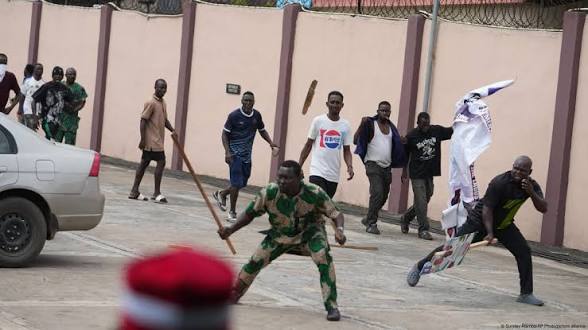
•Economic experts list how violence drives more Nigerians into poverty, scares investors
•85 killed in October as political tension mounts
Nigeria is entering another election season in a familiar way — with skirmishes, threats and intimidation as political parties mobilise supporters and prepare for the battle ahead. But election violence is not merely a threat to a peaceful vote. It strikes at the heart of democracy itself: the ability of the state to guarantee the freedom and security on which multiparty politics rests.
More troubling, however, is the growing realisation that political violence carries consequences far beyond the electoral arena. It can undermine investor confidence, trigger capital flight, weaken the national currency, disrupt economic activities and ultimately deepen the hardship confronting ordinary Nigerians.
The warning is no longer abstract. On November 15, the Centre for the Promotion of Private Enterprise (CPPE) warned that rising political violence could trigger capital flight and weaken the naira. In its policy brief, Political Violence and Institutional Neutrality: Safeguarding Investor Confidence Ahead of the 2027 Elections, the organisation said: “The growing incidence of politically induced violence, intimidation and inflammatory rhetoric raises serious concerns about the implications for economic stability and investor confidence.”
Investors do not necessarily wait for elections to turn bloody before reconsidering their exposure to a country. They respond to early warning signals that suggest political instability, uncertainty over government policies and the possibility of disruptions to economic activities.
CPPE put it bluntly: “Political violence is not merely a threat to democratic governance; it constitutes a significant economic risk with far-reaching consequences.”
That is the real cost of election skirmishes. A thug disrupting a political rally in one state does not merely frighten voters in that locality. He sends a troubling signal to a factory owner in Lagos, a farmer in Benue and a fund manager in London that Nigeria may be struggling to guarantee the stability required for productive investments.
Beyond the immediate threat of capital flight, the Chief Executive Officer of CPPE, Dr Muda Yusuf, explained in a telephone discussion with Sunday Sun how political uncertainty and election-induced violence could undermine macroeconomic stability and worsen the living conditions of ordinary Nigerians.
According to him, although it may be difficult to establish a direct causal relationship between the current exchange-rate pressure and political developments, electioneering expenditure and capital flight remain possible contributing factors. “There are a number of possible factors that can put pressure on the naira. If you look at what is happening to the exchange rate, there is already pressure on the naira. But it is difficult to say the exact cause. This may be as a result of capital flight, or as a result of electioneering spending. Those are the two possibilities,” he explained.
Yusuf’s argument goes beyond the immediate impact of violence. He noted that political transition periods are traditionally associated with uncertainty, particularly among investors who may be apprehensive about the direction of government policies after an election. Such uncertainty can encourage capital-flow reversals even before any actual breakdown of law and order.
“But the point I’m making is that usually, political transition periods normally come with some level of uncertainty. So those things normally increase the risk of capital flow reversals because people are not sure exactly how things will move. Capital flight is not only because of the issue of violence, but because they don’t know what will happen to government policy. Violence is a factor, policy risk is a factor, political risk is a factor,” he said.
His qualification is important. It would be misleading to attribute every movement in the exchange rate to political violence when several economic and external factors are at play. Nevertheless, the danger is that escalating political tension could compound existing vulnerabilities and undermine some of the gains recorded through ongoing economic reforms.
Yusuf acknowledged that investor confidence and macroeconomic stability are among the gains of the current reform programme, warning that an escalation of violence could jeopardise those gains.
The ultimate victims, however, would not necessarily be the political actors or wealthy investors who could move their resources elsewhere. They would be ordinary Nigerians whose purchasing power is already under pressure. “If the macroeconomic environment becomes unstable in terms of swirling inflation — there is a very strong relationship between the exchange rate and inflation rate. Inflation affects cost of living, it affects welfare, it affects purchasing power. So it will affect macroeconomic stability,” he warned.
To put it more succinctly, the consequences of political violence could travel from the campaign ground to the foreign-exchange market and eventually to the neighbourhood market where families struggle to afford food, transportation and other necessities. A weaker naira can increase the cost of imported inputs, production and distribution, with the resulting pressure eventually passed on to consumers.
Yusuf nevertheless believes that the extent and duration of the economic consequences would depend considerably on the credibility of the electoral process.
“If the electoral process is credible, free and fair, normalcy will return soon after the elections,” he said, urging all critical stakeholders to abide by the rules and ensure a credible electoral contest.
This is a significant point. Political uncertainty is not necessarily permanent. A transparent election, accepted by the contestants and supported by credible institutions, can restore confidence and encourage investors to maintain or expand their commitments. Conversely, a disputed election accompanied by violence and institutional manipulation could prolong uncertainty and make economic recovery more difficult.
Not everyone, however, shares the apprehension that the approaching general election could degenerate into widespread violence or trigger serious capital flight.
APC chieftain and former Ogun State Deputy Governor, Senator Gbenga Kaka, dismissed the fears, arguing that the present political atmosphere is considerably calmer than what the country experienced during previous election cycles.
“We have had more volatile election campaigns in this country than the current one. And I don’t foresee any serious violence, other than these skirmishes, ahead of the 2027 general election,” he said.
Kaka pointed to the relatively peaceful conduct of party primaries and what he described as the subdued nature of current electioneering activities as reasons for his optimism. “We have had primaries, and there was no bloodshed accompanying them. Even the ongoing electioneering has not assumed the momentum expected of it. Beyond some billboards here and there, there is not much activity going on as it used to be. Many of the opposition candidates have gone to bed to sleep,” he added.
He also dismissed the suggestion that the current political atmosphere had created sufficient grounds for investors to panic, arguing that the foreign-exchange market was stabilising and that security agencies remained capable of containing isolated incidents.
“I have not seen any serious violence recorded so far, and I don’t envisage any, talk less of one that would affect investors. Besides, foreign exchange is being stabilised. So there is nothing yet to warrant the anxiety people are trying to generate,” he added.
While acknowledging the existence of occasional skirmishes, Kaka maintained that they should be treated as warning signals rather than evidence of an impending breakdown of security. “If anybody refuses to campaign till the election comes and resorts to violence, he will face the music. By the time they make a scapegoat of one or two, others will refrain from violent activities,” he said, expressing confidence in the capacity of security operatives to contain potential threats.
His position provides a counterpoint to the concerns raised by CPPE. Yet, the absence of widespread violence at this stage should not be mistaken for a guarantee of peaceful elections. Campaign activities will intensify, political competition will become fiercer, and the stakes will rise as parties approach the actual voting period. The appropriate response, therefore, is neither to exaggerate the threat nor to dismiss the warning signs, but to ensure that security institutions are adequately prepared to prevent isolated incidents from escalating.
According to available reports, October alone recorded at least 835 security-related deaths — the highest monthly toll of this campaign season. For many communities, insecurity is not an abstract political argument. It means bandits on farm roads, kidnappers on highways and political thugs disrupting rallies. All of these developments reinforce the perception that the state is struggling to protect its citizens.
That is why the warning from Finance Minister Taiwo Oyedele on November 17 matters. He said negative narratives about Nigeria have become an economic problem in themselves, pushing investors away and accelerating the Japa syndrome. He also acknowledged the disconnect between official inflation figures and the everyday experiences of Nigerians who continue to grapple with the high cost of bread, milk, transportation and other essentials.
When citizens do not believe that the state can protect their lives and property, it becomes increasingly difficult to convince them that the economy is on a sustainable path to recovery.
“Political competition is a legitimate feature of democracy. However, when it degenerates into violence, institutional manipulation and disregard for due process, the consequences extend beyond politics to investment decisions, business operations, employment and economic growth.”
The International Monetary Fund (IMF) did not specifically warn about election violence, but its assessment underscores the economic vulnerability that makes insecurity particularly dangerous. In its 2026 Article IV Consultation, the Fund said: “Insecurity takes a heavy human toll, and impacts investment, agriculture, and oil production.”
It also warned that reform momentum could slow as elections approach, as politicians face pressure for higher spending. Taken together, the CPPE and IMF assessments describe a country that is both politically vulnerable and economically exposed.
Electioneering promises
Against this background, security has inevitably become a major component of the political campaigns ahead of 2027. The leading presidential contenders agree on one fundamental issue: Nigeria cannot achieve sustainable economic growth without addressing its worsening security challenges. Where they differ is in their proposed approaches, priorities and capacity to deliver.
In his 109-page manifesto, From Reform to Prosperity: Agenda 2027–2031, launched on November 10, President Bola Tinubu promises 78,000 additional security personnel, comprising 50,000 police officers and 28,000 military recruits, alongside 30,150 NSCDC personnel. His proposals also include four new Army divisions in Makurdi, Ilorin, Jalingo and Benin City, body cameras and a police-to-citizen ratio of 1:400.
The strength of the proposal lies in its specificity and emphasis on expanding the country’s security architecture. However, the central question for voters is whether the administration can translate these promises into measurable improvements, having already spent a considerable part of its first term battling insecurity.
His manifesto itself concedes that the work is far from complete. Voters will therefore demand explanations about the gaps in the existing security framework and how the proposed recruitment and expansion will address them.
Peter Obi, running with Rabiu Kwankwaso, offers a different proposition. Rather than emphasising numerical targets for recruitment, his campaign places considerable emphasis on intelligence-driven operations, community-based security and decisive leadership. He has promised to declare a security emergency and personally visit conflict zones to assess situations and demonstrate leadership.
His recent visit to Yelewata in Benue State and promise of an agricultural emergency underscore his argument that security and economic productivity are inseparable. His proposition is that farmers must first be protected before the country can expect a meaningful improvement in food production and prices.
The strength of this approach is its recognition that insecurity is not simply a military problem but also a threat to livelihoods, food security and national development. Its weakness, however, is the need for greater clarity on the institutional arrangements, funding and operational framework required to translate the promises into results.
Atiku Abubakar makes perhaps the most ambitious promise: to end insecurity within one year. “I will not take more than one year to end it. We will recruit additional security personnel and provide them with the necessary equipment. We will also provide adequate funding to support youths to establish businesses,” he told BBC Hausa.
His argument is fundamentally economic: expanding employment opportunities and supporting young entrepreneurs would reduce the attraction of banditry and other criminal activities among vulnerable youths. He also advocates a regional security response through the revival of ECOMOG and efforts to bring Niger, Mali and Burkina Faso back into ECOWAS.
The strength of this proposition is its recognition that insecurity is both a security and an economic problem. Its weakness is the ambitious one-year deadline for resolving a crisis that has persisted for more than a decade. His proposal to restore fuel and electricity subsidies also raises questions about fiscal sustainability, particularly against the background of projections that debt servicing could consume as much as 72 per cent of government revenue by 2030.
On paper, Tinubu offers structure, Obi offers leadership, while Atiku offers speed. But voters in Benue, Zamfara and Plateau are unlikely to be persuaded by manifestos alone. Their most immediate concern is whether they can return to their farms without fear, travel safely on highways and receive protection from security agencies when threatened.
How violence makes hardship worse
The economic consequences of insecurity and political violence are not difficult to identify. CPPE explained that “political violence could create investment uncertainty, discourage new investments, delay expansion plans and increase the risk premiums demanded by investors.”
The first casualty is agricultural production. When rural roads become unsafe, farmers in Benue, Plateau, Zamfara, Kaduna, Niger and Borno are forced to reduce cultivation or abandon their farms altogether. This affects food supply, increases pressure on prices and deepens the hardship of households already struggling with the cost of living.
That is why the reported food inflation rate of 19.13 per cent in October, despite the decline in headline inflation to 14.06 per cent, remains a source of concern. The projection that 34.7 million Nigerians could face acute food insecurity in 2026 further underscores the urgency of addressing the security challenges affecting agricultural production.
Second, transportation and distribution networks suffer. Clashes, roadblocks and attacks on highways disrupt supply chains and market access. Traders and transport operators are compelled to spend more on security, take alternative routes or suspend operations altogether. These additional costs eventually find their way into the prices consumers pay.
Third, investor confidence suffers, with possible consequences for the foreign-exchange market. CPPE warned that “prolonged political instability can weaken investor sentiment, trigger portfolio outflows and intensify foreign-exchange volatility.”
This concern is particularly relevant given the structure of Nigeria’s capital inflows. Available figures indicate that 85 per cent of the country’s $23.22 billion capital inflows in 2025 came from portfolio investment rather than foreign direct investment. In the first quarter of 2026, portfolio investment reportedly accounted for 95.1 per cent of inflows, while foreign direct investment represented only 1.3 per cent.
Unlike investments in factories, infrastructure and other productive assets, portfolio investments can be withdrawn relatively quickly when investors perceive heightened risks. A combination of political uncertainty, policy unpredictability and insecurity could therefore expose the economy to sudden capital reversals.
This is where Yusuf’s warning about the relationship between exchange-rate instability and inflation becomes particularly relevant. When investors withdraw funds and foreign-exchange pressures intensify, the consequences can extend to the prices of imported goods, production inputs and essential commodities. The resulting inflation erodes household incomes and weakens purchasing power.
Thus, the economic burden of election violence is not confined to the wealthy investor who moves capital elsewhere. It is ultimately transferred to the ordinary citizen who must pay more for food, transportation, healthcare and other necessities.
Breaking the cycle
If 2027 is to be different, three things must happen before election day, not after. First, political parties must demonstrate a genuine commitment to peaceful campaigns by disowning violence in practice rather than merely issuing statements condemning it. A party that sponsors thugs to disrupt a rival’s rally has already communicated a troubling message about its attitude towards democratic competition and the rule of law.
Political leaders must also rein in their supporters, avoid inflammatory rhetoric and accept that the legitimacy of an electoral victory depends on the credibility of the process through which it is obtained.
Second, institutions must act proactively. INEC must demonstrate its capacity to conduct a credible election, while security agencies must show that their responsibility is to protect all citizens and political actors, irrespective of party affiliation. The police must be seen to protect voters rather than VIPs, while the courts must demonstrate their readiness to dispense electoral justice without unnecessary delays.
Swift investigation and prosecution of electoral offenders would send a stronger message than the numerous peace accords that political parties routinely sign ahead of elections but often disregard when the contest becomes intense.
Third, citizens must refuse to be divided along political and ethnic lines. The farmer in Benue, the trader in Onitsha, the technology worker in Lagos and the student in Sokoto are not enemies. They are all vulnerable to the consequences of insecurity, economic instability and poor governance.
Ultimately, the argument is not that every political disagreement will trigger capital flight or that every campaign skirmish will destabilise the naira. As Yusuf rightly observed, several factors influence exchange-rate movements, and it would be difficult to establish a direct connection between a particular political incident and a specific economic outcome. But that uncertainty should not diminish the importance of preventing violence. It should instead reinforce the need to manage political risks before they become economic liabilities.
Nigeria does not lack security proposals or economic reform programmes. What it urgently needs is institutional credibility, political responsibility and public trust. Trust is built not at campaign rallies but in the quieter moments when a policeman refuses a bribe, a court delivers a fair judgment, a political rally ends without violence and a farmer returns from his field alive. It is also built when electoral institutions demonstrate neutrality and political leaders accept the outcome of a credible contest.
If Nigeria can protect these moments, it will not merely have a peaceful election. It will have taken a significant step towards restoring investor confidence, strengthening democratic institutions and creating the conditions for the prosperity all the presidential candidates promise.
If it cannot, whoever emerges victorious in 2027 will inherit not just a country struggling with insecurity and economic hardship, but a deeper crisis of confidence. And no number of additional soldiers, new military divisions or elaborate campaign manifestos will be sufficient to resolve it.