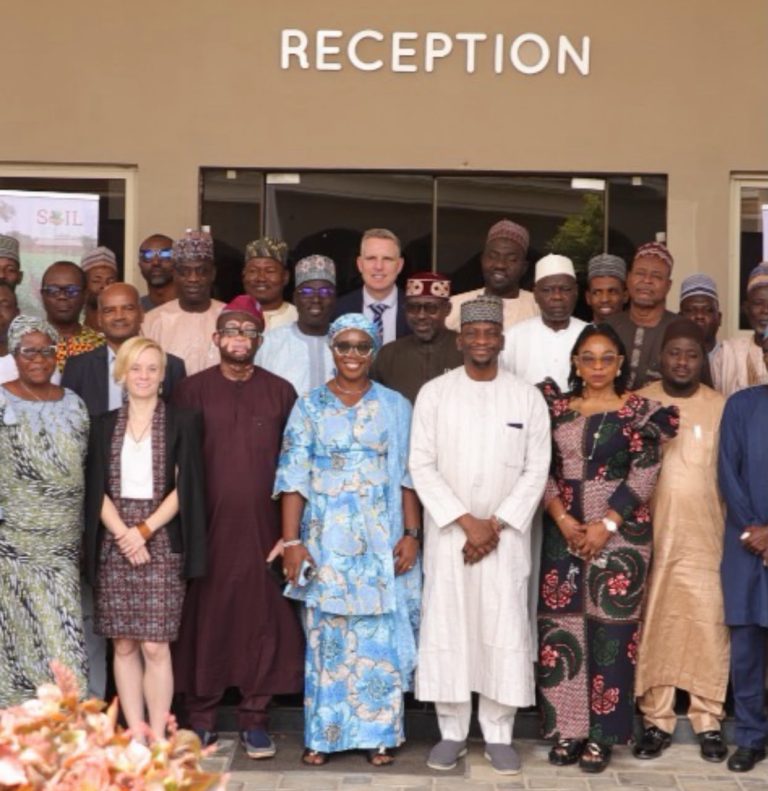
The Soil Values Program has organized a two-day workshop to strengthen collaboration among agricultural stakeholders towards improving soil health and agricultural productivity in Nigeria.
The workshop, organized by the Soil Values Program, implemented by the International Fertilizer Development Centre (IFDC) brought together government officials, researchers, development partners, farmers’ organizations and private-sector on the 21 and 22 of October, 2026 in Kano.
Medinah Ayuba-Fagbemi, Country Coordinator of the Soil Values program and IFDC Nigeria, said the initiative aimed to promote healthier soils, higher productivity and climate-resilient farming systems across the Sahel.
Medinah said the workshop provided a structured multi-stakeholder platform for identifying challenges and developing joint actions to address persistent soil fertility problems.
She noted that although Nigeria had several institutions and investments in agricultural development, inadequate coordination often resulted in overlapping program and missed opportunities to leverage available resources and expertise.
According to her, farmers need integrated support, including soil information, appropriate agricultural inputs, advisory services, financing, market access and supportive public institutions to improve soil fertility.
She said discussions at the workshop would focus on soil intelligence and advisory services, agricultural inputs and last-mile delivery, financing soil health, markets, and landscape and institutional scaling.
Medinah urged participants to identify practical areas of collaboration, make realistic commitments and agree on concrete actions that would benefit small holder farmers.
“Our measure of success is not the quality of our discussions. It is a pipeline of partnerships that move into pilots, technical cooperation and co-investment that our smallholder farmers can feel on their land,” she said.
She said the Soil Values Program, which runs from 2024 to 2033, was funded by the Dutch Directorate-General for International Cooperation (DGIS).
The program is led by IFDC in consortium with SNV and Wageningen University and Research, alongside knowledge partners, including IITA, AGRA, ICRAF, IWMI and ISRIC.
On his part, Dr Kingsley Uzoma, Senior Special Assistant to the President on Agribusiness and Productivity Enhancement, represented by Dr Tahir Lawan Dalorima, said healthy soils were essential to food security, agricultural competitiveness and sustainable rural development.
He said the Federal Government’s Nigerian Farmers Soil Health Scheme represented an important step towards evidence-based soil management.
Uzoma noted that plans announced by the Federal Ministry of Agriculture and Food Security in May 2026 included a readiness assessment supporting 774 soil-testing laboratories, one in each Local Government Area, with the capacity to test two million farms annually.
He, however, stressed that the success of soil health initiatives should be measured by farmers’ adoption of recommendations, improved yields, reduced production costs and more resilient agricultural livelihoods.
He called for accessible soil testing, locally appropriate fertiliser recommendations, integrated nutrient management and climate-smart farming practices.
Similarly, Dr Oshadiya Olanipekun, Director of Land and Climate Change Management Services at the Federal Ministry of Agriculture and Food Security, represented by Mrs Iyabo Lawal Mustafa, said soil health was fundamental to agricultural productivity, food security and environmental sustainability.
He called for stronger coordination among government institutions, research organisations, development partners and farmers to improve access to soil testing, agricultural extension, financing and appropriate fertiliser recommendations.
During a panel discussion titled “Beyond Institutional Silos: What Will It Take to Transform Soil Health and Agricultural Services in Nigeria?”, participants emphasised the need for stronger collaboration, private-sector engagement, capacity building and advocacy.
They said coordinated interventions would help improve soil management and ensure that research, agricultural investments and policy commitments translated into tangible benefits for farmers.
Participants included representatives of the Federal and Kano State Governments, the Centre for Dryland Agriculture at Bayero University, Kano, the All Farmers Association of Nigeria, the Small-Scale Women Farmers Organisation in Nigeria, ACReSAL, NIRSAL, research institutions and other agricultural stakeholders.