BY TAIWO OGUNMOLA -OMILANI
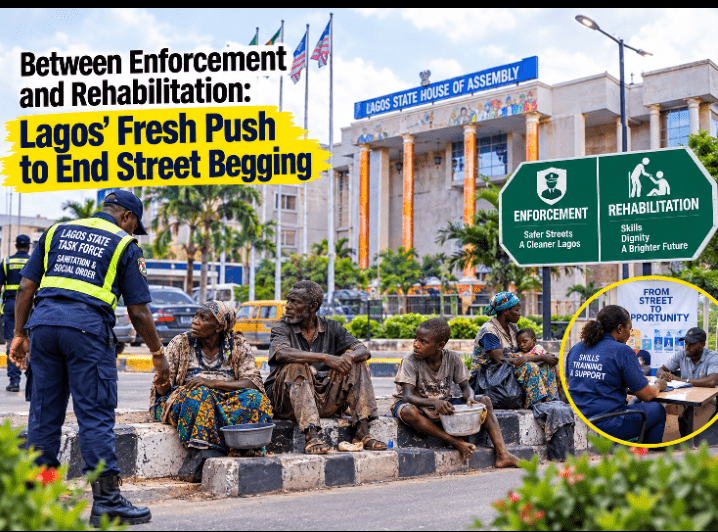
The proposed Lagos State street-begging law raises questions beyond enforcement: how the State can reclaim public spaces while protecting vulnerable people, especially children, and addressing the circumstances that push people onto the streets.
Lagos, street begging has become an increasingly familiar feature of daily life. From the Lekki-Epe corridor to Eti-Osa, Ikotun-Egbe, Abule-Egba, Mile Two and Ajegunle, beggars can be seen at roadsides, traffic intersections and road medians, often approaching motorists and pedestrians for money.
The situation formed part of the concerns raised at a recent public hearing organised by the Lagos State House of Assembly on a proposed law to prohibit street begging and street urchins in the State.
The hearing, chaired by the Chairman, House Committee on Youth, Sport and Social Development, brought together stakeholders who described the proposed legislation as long overdue. They pointed to the growing presence of beggars across different parts of the State and the challenges their activities pose to public safety, traffic and the image of Lagos as a megacity.
For many Lagosians, however, the issue is not simply about people asking for money on the streets. Stakeholders at the hearing also raised concerns about the manner in which some begging activities are carried out, particularly at night, when passers-by may allegedly be confronted or pressured to give money.
The proposed legislation seeks to establish a legal framework for addressing the problem while providing rehabilitation and welfare measures for people found begging on the streets.
Under the bill, a person or group of persons who loiter in a public or private place in a manner that obstructs traffic or causes public nuisance for the purpose of begging would commit an offence.
It also targets people who sleep, reside or establish temporary or permanent structures in public or private places for the purpose of begging, as well as groups that assemble for the purpose of begging.
But the proposed law does not stop at prohibition and punishment. A major component is the establishment of a Rehabilitation and Welfare Centre by the relevant ministry.
According to the bill, the centre would provide temporary custody for persons apprehended under the law, training and social welfare assistance. It would also offer vocational training, literacy programmes, psychological counselling and life-skills education.
This provision is significant because street begging often involves people whose circumstances may extend beyond the immediate act of asking for money. The proposed framework therefore envisages rehabilitation and reintegration alongside enforcement.
Children are given separate protection under the proposed law. Any child apprehended would be treated in accordance with the Child Rights Protection Laws and handed over to the appropriate child welfare authority in the State.
The bill also provides for collaboration with non-governmental organisations, faith-based organisations and community development structures in its implementation.
At the same time, the legislation gives enforcement officers substantial powers. The Environmental Sanitation Corps Agency would be responsible for enforcing the law, including arresting and prosecuting persons who contravene its provisions.
An authorised officer may arrest without a warrant a person found committing an offence or reasonably suspected of committing one. Items allegedly used in committing an offence may also be seized, while arrested persons are to be handed over to the police after preliminary enquiries and investigation.
The proposed penalties are graduated. A first offender would be warned and referred to the Rehabilitation and Custodial Centre. A second offender could face a fine of up to N200,000, a non-custodial sentence of up to three months, or both.
The bill, however, places safeguards around enforcement. It provides that all enforcement actions must comply with Chapter IV of the 1999 Constitution, as amended. Persons arrested must not be subjected to torture, inhuman or degrading treatment or unlawful detention.
The proposed law also provides for profiling and documentation of persons apprehended, with referrals for appropriate legal or rehabilitation processes. Both the High Court and Magistrate Court would have jurisdiction to try offences under the law.
The central question for Lagos may therefore be how effectively the proposed legislation can combine enforcement with rehabilitation.
For residents who encounter begging at busy roads and intersections, effective enforcement could mean safer and less obstructed public spaces. For vulnerable adults and children living or begging on the streets, however, the rehabilitation provisions could determine whether the law merely moves people away from the roads or actually helps them transition into more stable lives.
As the Lagos State House of Assembly considers the bill, attention will consequently extend beyond its passage to how its provisions are implemented, how enforcement officers exercise their powers, and whether the proposed rehabilitation system receives the resources required to fulfil its purpose.
For Lagosians who participated in the public hearing, the expectation is clear: a sustainable response to street begging that gives residents greater safety and breathing space while ensuring that vulnerable people, particularly children, are not simply removed from the streets without a pathway to rehabilitation and reintegration.