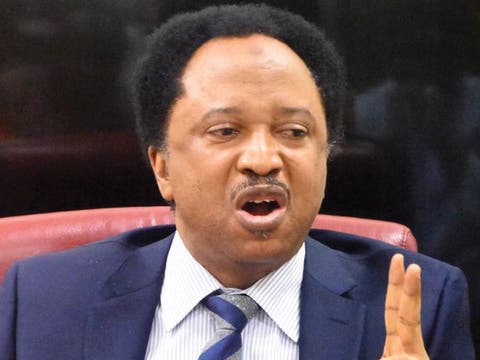
Senator Shehu Sani has described the promise by the African Democratic Congress (ADC) presidential candidate, Atiku Abubakar, to restore the fuel subsidy as a “Trojan horse” and an impracticable campaign strategy to win votes ahead of the 2027 general election.
Sani, who represented Kaduna Central in the eighth Senate, made the remarks while speaking to journalists in Abuja.
The former lawmaker said he was surprised that Atiku, a former Vice-President and veteran politician, would promise to reverse the subsidy removal despite his long-standing support for economic policies associated with the World Bank and the International Monetary Fund (IMF).
He described the pledge as “outright deception of Nigerians”, arguing that Atiku had consistently supported subsidy removal throughout his political career and previous campaigns.
“What he is saying is outright deception of Nigerians,” Sani said.
He added, “As someone who has always subscribed to Bretton Woods Institution neoliberal economic policies, someone who believes in World Bank and IMF prescriptions, devaluation of currency, privatisation of public enterprises and all sorts of capitalist bourgeoisie economic policies, and someone who has, throughout his political history and campaigns, stood for the removal of subsidy, for someone now to make a reversal simply because he needs votes, there is a need for Nigerians to seriously not take what he has said at face value.”
Sani argued that returning to fuel subsidy would be impracticable, recalling that the country had spent trillions of naira subsidising petroleum products, while neighbouring countries allegedly benefited from the arrangement through fuel smuggling.
“For a number of reasons, what he said is virtually impracticable,” he said.
The former senator also alleged that the subsidy regime created opportunities for fraud, with some beneficiaries accused of diverting hundreds of billions of naira under the guise of importing petroleum products.
“We have also seen how beneficiaries of subsidies use this mantra of subsidy to defraud our country. Many of them have cases in court where hundreds of billions of naira were looted and diverted from the national treasury in the name of importing petroleum products under the subsidy regime,” he said.
According to him, removing the subsidy has freed resources for state and local governments to fund development projects.
“Now, the removal of subsidy has also been able to provide resources for sub-nationals, for state governments and local governments, for them to be able to build roads, schools and hospitals,” Sani said.
He questioned the sustainability of returning to subsidy at a time when a significant portion of the nation’s revenue is being deployed to service debt.
Rather than promising to subsidise imported petroleum products, Sani urged politicians to focus on reviving Nigeria’s refineries and ensuring that the country refines its crude oil domestically.
“If any politician makes pledges to revamp our refineries so we can refine our own crude oil, then he is making sense,” he said.
Sani also rejected the argument that restoring the fuel subsidy would automatically bring down the cost of living.
“And let us not deceive ourselves. The return of the subsidy will not bring down commodity prices. It will simply distort the economic stability of our country,” he said.
The former senator further cautioned political parties and candidates against inflammatory rhetoric, ethnic mobilisation and appeals to religious sentiment ahead of the 2027 elections.
He urged politicians to campaign on issues, programmes and facts, warning that Nigeria had already experienced the devastating consequences of ethnic and religious conflicts.
“Nigeria has gone into war and crisis, and we also have that experience as a nation in the ’70s, and we have passed through all those spaces, and ought to have overcome all those things now,” he said.
“The use of ethnic groups and religions to undermine, destroy, damage and attack parties and candidates is not universal.”
Sani also criticised the opposition for allegedly seeking external validation in its quest to defeat President Bola Ahmed Tinubu, particularly through appeals to United States President Donald Trump and the European Union.
He described the approach as an attempt to “decolonise” Nigerian politics and to take domestic political contests outside the country.
“The idea of seeking an easy route to power by striving to secure validation from President Donald Trump and the EU is not helpful to our democracy,” Sani said.
He urged opposition parties to focus on convincing Nigerian voters rather than seeking external intervention to disqualify the President or frustrate his political ambition.
“Opposition should concentrate on issues and make themselves available and appeal to the electorate rather than trying to criminalise the President or his political ambition or seek President Trump or the EU to disqualify him,” he said.
Sani argued that attempts to involve foreign powers in Nigeria’s political affairs could damage the country’s image and undermine its status as an independent African nation.