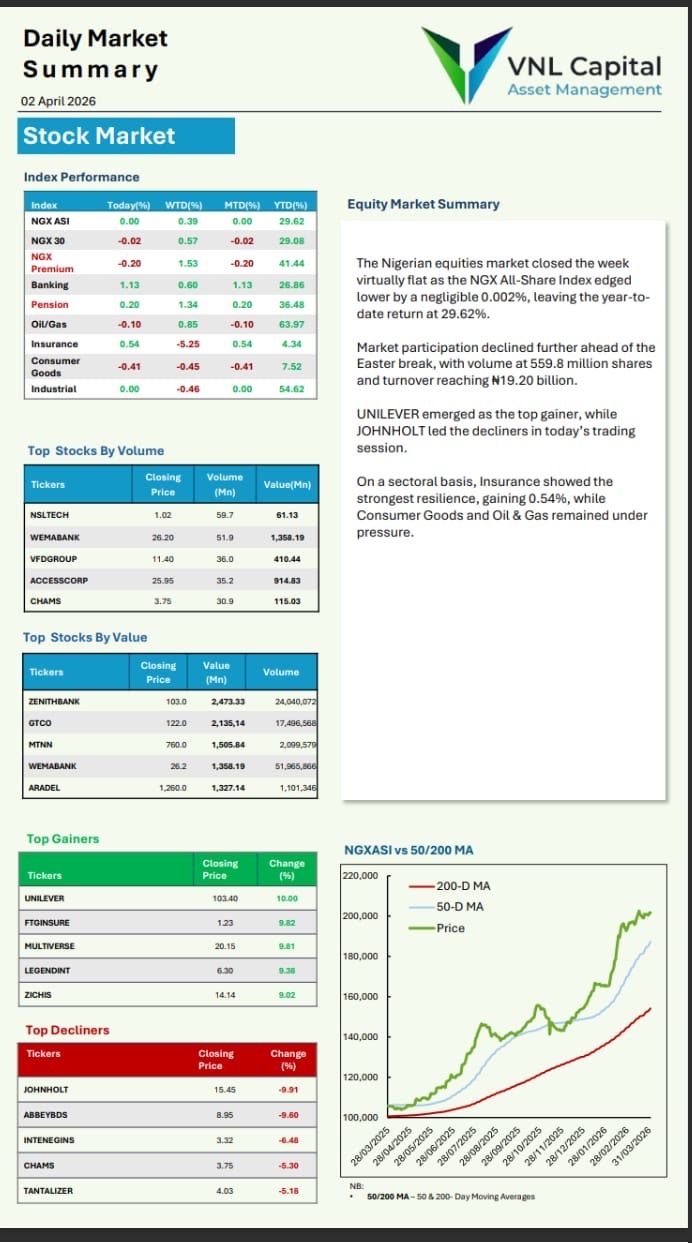
The Nigerian equities market closed the week on a largely flat note, with the NGX All-Share Index slipping marginally by 0.002 per cent, while the year-to-date return settled at 29.62 per cent.
Market activity weakened further ahead of the Easter holiday, as total traded volume stood at 559.8 million shares, with turnover closing at ₦19.20 billion.
In the day’s trading, UNILEVER posted the strongest gain, while JOHNHOLT recorded the biggest loss. Across sectors, the Insurance index showed the most resilience, advancing by 0.54 per cent, while Consumer Goods and Oil & Gas sectors remained under pressure.
In the fixed income market, the overnight (O/N) rate extended its upward movement, rising by one basis point to 22.31 per cent, while the Open Repo Rate (OPR) held steady at 22.0 per cent.
The local bond market remained relatively quiet, with yields mostly unchanged across the curve. However, the 25-Jun-32 bond saw a notable increase of 13 basis points, while 2028 papers rose slightly by one basis point.
Investor demand remained strong in the Treasury bills market, leading to further yield compression. Average yields declined by four basis points, with the most pronounced drops recorded in the 7-Jan-27 and 18-Feb-27 maturities, which fell by 22 basis points and 19 basis points respectively.
In the Eurobond market, buying interest was concentrated at the short end of the curve, particularly in the 28-Nov-2027 and 28-Sep-2028 instruments, where yields declined by two basis points and four basis points respectively. Other maturities, however, faced notable sell pressure, with yields rising between eight basis points and 15 basis points.
At the foreign exchange market, the naira weakened against the dollar, with the USD/NGN pair closing at ₦1,380.79 after gaining 0.2 per cent, while year-to-date appreciation remained at 3.3 per cent. The EUR/NGN settled at ₦1,591.34 after a 0.7 per cent decline, while the GBP/NGN closed at ₦1,824.20, down by 0.6 per cent.
Nigeria’s foreign reserves also continued their downward trend, falling further to $49.29 billion, extending the decline from the $50 billion mark recorded in mid-March 2026.
Meanwhile, in the commodities market, Brent crude oil surged by 4.6 per cent to $106.71 per barrel, driven by renewed geopolitical tensions in major producing regions and expectations of tighter global supply.