BY TAIWO OGUNMOLA -OMILANI
The Petroleum and Natural Gas Senior Staff Association of Nigeria (PENGASSAN) has criticised the Federal Government’s executive order mandating direct remittance of oil and gas revenues to the Federation Account, warning that the policy could undermine investor confidence and destabilise the industry.
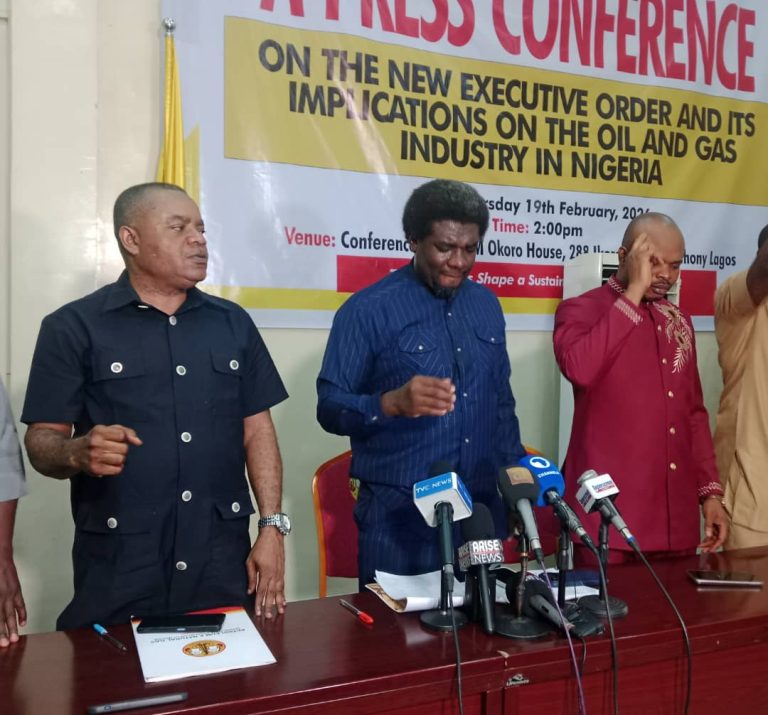
Speaking at a press conference on Thursday, PENGASSAN President Festus Osifo said the directive contradicts key provisions of the Petroleum Industry Act (PIA) and could trigger industrial unrest and potential job losses.
“Executive Order Cannot Override the Law”
President Bola Ahmed Tinubu recently signed an executive directive requiring the direct payment of oil and gas revenues into the Federation Account, effectively eliminating deductions previously permitted under the PIA.
Osifo argued that the move cannot supersede an Act of the National Assembly.
“An executive order cannot override the law of the land. What has been done amounts to setting aside sections of the Petroleum Industry Act. This is troubling and sends a wrong signal to investors,” he said.
He noted that PENGASSAN participated in the formulation of the PIA through public hearings and engagements with lawmakers to ensure regulatory certainty capable of attracting both international and indigenous investors.
According to him, the directive risks eroding the predictability the sector gained after the law was enacted, recalling that investments declined for nearly a decade prior to the PIA due to fiscal uncertainty.
“Globally, there is competition for petrodollars. Investors need clarity. If an executive order can change fiscal terms overnight, they may choose to invest elsewhere,” he added.
Osifo also disputed claims that about 30 per cent of production-sharing revenue goes to the Nigerian National Petroleum Company Limited (NNPC Ltd.), insisting the actual figure is significantly lower.
PENGASSAN warned that the policy could affect thousands of workers across the sector if implemented without review.
“We have nearly 4,000 Nigerians working in affected operations. If this continues, redundancies could occur and industrial crises may follow,” Osifo said.
The union urged the Federal Government to review the directive and engage stakeholders to avoid damaging the oil and gas sector, which has sustained Nigeria’s economy for over five decades. It maintained that reforms should be pursued through legislative amendments rather than executive directives to preserve regulatory stability and investor confidence.
Key Provisions of the Executive Order
The executive order, signed on February 13, 2026, and immediately gazetted, seeks to restore full constitutional revenue entitlements to federal, state and local governments by eliminating what the Presidency described as excessive and duplicative deductions reducing inflows to the Federation Account.
Major provisions include:
Ending NNPC Limited’s 30% management fee on Profit Oil and Profit Gas from Production Sharing, Profit Sharing and Risk Service Contracts, on the grounds that the existing 20% profit retention already covers operational needs.
Abolishing NNPC’s 30% retention for the Frontier Exploration Fund under Sections 9(4) and (5) of the PIA, with all funds now transferred directly to the Federation Account.
Requiring operators and contractors to remit Royalty Oil, Tax Oil, Profit Oil, Profit Gas and all other government entitlements directly to the Federation Account effective February 13, 2026.
Suspending payment of gas flare penalties into the Midstream and Downstream Gas Infrastructure Fund (MDGIF), with all future penalties to be paid into the Federation Account and existing expenditures subjected to public procurement laws.
PENGASSAN insisted continued dialogue is necessary to balance government revenue objectives with investment stability and employment protection in the petroleum sector.