
Ekiti State Governor, Mr. Biodun Oyebanji, has reaffirmed his administration’s commitment to making quality healthcare a right rather than a privilege for all citizens.
He emphasized that improved access to healthcare would boost life expectancy and consolidate the state’s achievements in reducing child and maternal mortality rates.
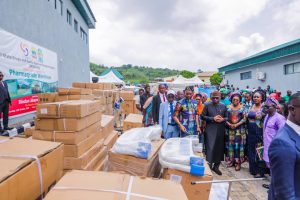
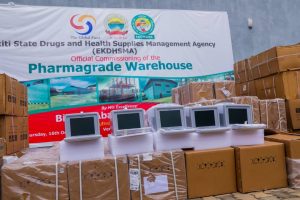
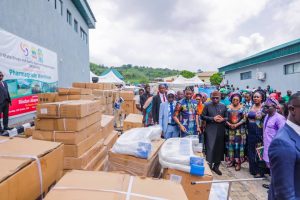
Speaking in Ado-Ekiti on Thursday during the flag-off of medical equipment distribution to Primary Healthcare Centres (PHCs) and the commissioning of a Pharma-Grade Warehouse within the precinct of the Ekiti State University Teaching Hospital (EKSUTH), Oyebanji said his government would tackle the menace of counterfeit drugs head-on.
He warned that fake and substandard drugs pose a grave threat to public health, often resulting in avoidable deaths and complications.
According to him, the new pharma-grade warehouse, built with the support of the Global Fund, represents a major step toward ensuring a safe, transparent, and efficient drug management system in Ekiti State.
“This facility will guarantee the continuous availability of quality, safe, and affordable medical supplies for hospitals and health centres across the state,” the Governor said. “It is not just an investment in infrastructure but an investment in the health security of our people.”
Oyebanji explained that the warehouse will help prevent stockouts, curb circulation of counterfeit medicines, and strengthen the capacity of the Ekiti State Drug Management Agency (DMA) to operate at the highest professional standards.
He disclosed that the Agency’s average monthly revenue has increased from ₦28 million to ₦75 million, reflecting greater efficiency, accountability, and sustainability in the state’s drug supply system.
The Governor also highlighted the impact of the Ulera Wa Health Insurance Scheme, revealing that over 200,000 residents have benefitted from it so far, while nearly 750,000 people have accessed healthcare services through the initiative since inception — significantly reducing out-of-pocket health spending
“Before the establishment of the Drug Management Agency, only about 43% of health facilities in Ekiti had regular access to essential medicines.
Today, that figure has risen to 89%. Primary healthcare coverage now stands at 80%, while both secondary and tertiary facilities have achieved 100% coverage,” Oyebanji said.
He further noted that the revitalization of 103 PHC facilities across the 16 local government areas under the World Bank-supported IMPACT project is a strategic investment toward achieving universal health coverage.
Oyebanji reaffirmed his administration’s commitment to improving the welfare of health workers, announcing the approval for the recruitment of 100 additional PHC staff and 150 for secondary health facilities to close manpower gaps.
Earlier, the Commissioner for Health and Human Services, Dr. Oyebanji Filani, lauded the Governor’s prompt approval of counterpart funding, which ensured the state’s inclusion in key global health interventions.