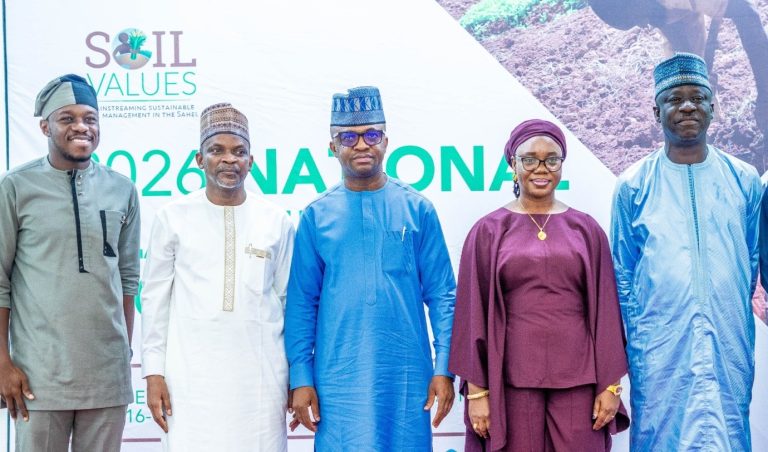
The Federal Government has commended The International Fertilizer Development Centre (IFDC) through its program Soil Values for its contributions to the development of agriculture in the country, which and aims to improve soil quality.
Senior Special Assistant to the President on Agribusiness & Productivity Enhancement, Dr. Kingsley Uzoma, made the disclosure on Tuesday in Abuja at the opening of the Three-Day 2026 National Workplan for Agriculture Development in Abuja.
The 2026 National Workplan Worshop draws about 50 participants from the three Pilot states of Kano, Jigawa and Bauchi is being sponsored by the The International Fertilizer Development Centre (IFDC) through its programme Soil Values, a DGIS funded Programme.
In his remarks, Dr Uzoma said President Bola Ahmed Tinubu is interested in the total transformation of the agricultural sector in Nigeria. “Because of the peculiarities of our environment, the Savannah and Sahel regions have suffered extensive degradation, rendering millions of hectares of agricultural land unproductive. That’s why the government is very happy with what the Soil Value Programme has come to do.”
Dr. Uzoma also acknowledged the contributions of The Livestock Productivity & Resilience Project (L-PRES) and Agro-Climatic Resilience in Semi-Arid Landscapes (ACReSAL) alongside efforts from other regions. He emphasized that the federal government is committed to working with partners at all levels to secure the agricultural sector’s future.
He reaffirming government’s readiness to extend partnerships across diverse platforms to drive agricultural transformation and ensure food security for all Nigerians.
Speaking at the event, Mrs. Medinah Ayuba-Fagbemi, Country Coordinator, Soil Values Programme Nigeria said, “the Sahelian countries, including Nigeria, are grappling with recurrent droughts, desertification, socio-political conflicts, and the devastating effects of climate change. Unfortunately, these challenges, compounded by inadequate investment and weak financing mechanisms, have led to declining soil fertility, land degradation, and food insecurity. Soil Values has come to change this narrative.”
She explained that the programme is designed to restore two million hectares of farmland while strengthening the resilience and well-being of 1.5 million farmers, with a particular focus on women and youth in agriculture.
According to her, the initiative promotes Integrated Soil Fertility Management (ISFM) and participatory landscape management to encourage sustainable farming practices across communities.
The programme is being implemented by the International Fertilizer Development Center (IFDC) in collaboration with SNV, Wageningen University and Research (WUR), and supported by knowledge partners such as AGRA, CIFOR-ICRAF, IITA, ISRIC, and IWMI.
Also speaking, Mr Sanusi Abubakar, National Programme Coordinator (NPC), Livestock Productivity & Resilience Project (L-PRES), noted that the project has successfully completed its medication and crisis prevention component, describing it as a major pillar of their mandate.
“This achievement is not just a milestone but also a strong foundation for the sustainability of our broader objectives,” he said. “We are deliberately working with Africans who have established companies in the ranching and soil value chain, with the aim of creating lasting opportunities along our stock sector. This remains one of the major projects we are advancing at the moment, and it speaks directly to our mandate of productivity and resilience.”
He further extended best wishes to the Soil Values Programme, promising that L-PRES activities will remain visible during festive seasons across the state.
“These partnerships reflect our vision of building bridges that will translate into real benefits for our communities and our agricultural ecosystem,” he added.
In the same vein, Mr. Abdulhamid Umar, NPC Agro-Climatic Resilience in Semi-Arid Landscapes (ACReSAL) commended the collaboration of the various initiatives aimed at boosting agriculture at the grassroots.
He particularly thanked the Federal Government and the World Bank as well as other donor agencies for their efforts which are aimed at improving soil yields not only in the northern part of the country, but all over the country.
The Soil Values Programme Nigeria reaffirmed its commitment to tackling land degradation, boosting agricultural productivity, and ensuring food security in the country through its 2026 National Workplan for Agriculture Development.
NOTE FOR EDITORS ABOUT IFDC, SOIL VALUES:
The Soil Values programme operates in a context marked by climatic and socio-economic challenges facing Sahelian countries, such as recurrent droughts, socio-political conflicts. desertification and the effects of climate change.
Accentuated by insufficient investments and inadequate financing mechanisms, these conditions exacerbate the degradation of soil fertility and health and food security in Sahelian countries.
Soil Values aims to improve soil fertility and productivity of 2 million hectares of agricultural land in the Sahel, while strengthening the resilience and well-being of 1.5 million farmers, with a particular focus on women and youth.
The program’s approach is based on integrated soil fertility management (ISFM) and participatory landscape management to promote the adoption by farmers of agricultural practices that are favourable and innovative for soil fertility.
The Soil Values program initiative is built around three intervention pathways (Agroecology, Inclusive Markets and Enabling Environment) and five intervention areas (Bundling, integrate, Brokering, Convening and Scoping & Learning).
Soil Values is implemented by a consortium led by IFDC, in collaboration with core partners SNV and Wageningen University and Research (WUR), as well as knowledge partners, such as AGRA, the Centre for International Forestry Research and World Agroforestry (CIFOR-ICRAF), the International Institute of Tropical Agriculture (ITA), ISRIC – World Soil Information, and the International Water Management Institute (IWMI).
The IFDC is a public international organization, present in 27 countries, that combines scientific research and interventions to enable smallholder farmers in developing countries to increase their agricultural productivity and generate economic growth while promoting sustainability.