BY TAIWO OGUNMOLA -OMILANI
The Non-Academic Staff Union of Educational and Associated Institutions (NASU) has issued a stern warning to the Federal Government over the selective implementation of agreements and delays in payment within the tertiary education sector. The union cautioned that any bias in disbursing the promised N50 billion Earned Allowance could trigger a fresh wave of industrial unrest across Nigerian universities.
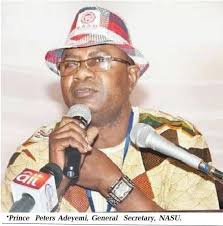
Speaking at the two-day Universities and Inter-University Centres Trade Group Council Meeting, NASU General Secretary, Prince Peter Adeyemi, lamented the persistent marginalization of non-teaching staff in the allocation of earned allowances.
“They have tried to divide the ranks of the unions, especially in the universities,” Adeyemi said. “When the earned allowance is released, 70 percent is allocated to academic staff, while only 20 percent is given to the three non-teaching staff unions. We protested against this imbalance.”
He recalled the 2022 strike that lasted four months, saying it was partially caused by the unfair treatment of non-teaching unions. According to him, a meeting chaired by former Education Minister Adamu Adamu led to a signed agreement in August 2022, in which the government committed to releasing N50 billion for earned allowances.
“That agreement remains binding. Yet, just a few days ago, we saw a circular indicating that a stakeholders’ meeting was held with only one union—ASUU—while excluding the three other unions. That cannot be considered a stakeholders’ meeting,” he said.
Adeyemi warned that any attempt to pay the N50 billion solely to the academic union would “plunge the universities into an industrial crisis.”
He appealed to President Bola Tinubu and the current Minister of Education to uphold equity and fairness in implementing the agreement, adding, “Government by its own action or inaction will set the university system into crisis.”
Adeyemi further stated that NASU supports the transition from the Integrated Personnel and Payroll Information System (IPPIS) to the Government Integrated Financial Management Information System (GIFMIS) — but only on the condition that all benefits and liabilities are carried over. “Unfortunately, IPPIS has failed in this regard,” he said.
He also condemned what he described as the illegal stoppage of check-off dues in some institutions, citing the Federal Polytechnic, Ekowe, as an example. “No rector, vice-chancellor, or provost has the power to stop union dues. It is a statutory right under Nigerian labour laws,” Adeyemi declared.
NASU President, Dr. Hassan Makolo, echoed similar sentiments, criticising the Federal Government for failing to pay arrears, implement IPPIS correctly, and renegotiate the 2009 agreement. He also decried NASU’s exclusion from recent stakeholder meetings.
“Enough is enough,” Makolo warned. “If the government continues to ignore us, we will resist.”
On his part, the Lagos State Chairman of NASU, Timothy Olawore, bemoaned the persistent challenges confronting the nation’s education sector, including inadequate funding, poor infrastructure, and brain drain. Despite the obstacles, he reaffirmed the union’s commitment to advocating for members’ welfare and sectoral reform.
The Trade Group Council Chairman and Deputy President of NASU, Buhari Suleiman, issued a damning assessment of Nigeria’s overall situation, citing critical failures in education, security, power, and the economy.
He condemned the Federal Government’s allocation of only 9.2 percent of the 2025 national budget to education, calling it a “clear disregard for global standards.”
Suleiman also lamented Nigeria’s slide to sixth place on the Global Terrorism Index, attributing it to failed leadership and rising insecurity. “No nation develops when its future—the youth—is abandoned,” he said.
He called for urgent reforms to end the power crisis, tackle corruption, and restore leadership that prioritizes the people’s welfare.