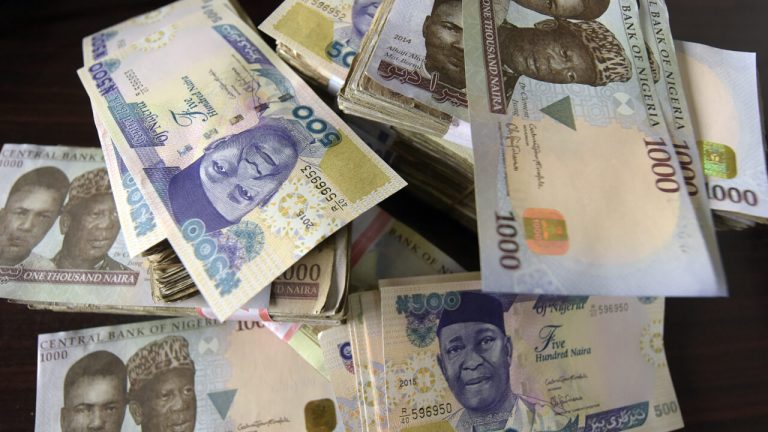
Manufacturers have predicted fresh hikes in the prices of commodities in the market to rise in response to the continued fall of the naira against the United States dollar.
On Friday, the naira plunged to N1,420/$ at the parallel window of the foreign exchange market.
The President of the Manufacturers Association of Nigeria, Francis Meshioye, on Saturday told The PUNCH that the naira, which has now remained at over N1,400 in the parallel market for two days, would lead to price hikes in the economy.
He said, “It is not possible to remain profitable with this exchange rate. The first challenge is breaking even. It means the prices of things will be higher, and the income is not there for people to buy things as they should buy as things become more expensive.
“So, the demand will become low, and this will affect our bottom-line. The break-even point will become critical. So, what businesses should do is to ensure that they break even at this time. It is a critical and very challenging time for us.”
Meshioye predicted that these price hikes were unlikely to resonate well with consumers whose spending power has been continuously depleted.
According to him, the frequent fluctuations in the forex market have made it difficult for manufacturers to make long-term plans.
The CBN on its part has begun to clear part of its backlog of matured foreign exchange obligations to Deposit Money Banks. So far, the bank has paid $2bn of an alleged $7bn backlog.
The CBN Acting Director of Corporate Communications, Hakama Sidi Alia, recently said, “These payments signify the CBN’s ongoing efforts to settle all remaining valid forward transactions, to alleviate the current pressure on the country’s exchange rate.
“It is anticipated that this initiative by the CBN should provide a considerable boost to the Naira hug against other major world currencies and further increase investor confidence in the Nigeria economy.”
Recently, the CBN governor, Olayemi Cardoso, announced that the Ministry of Finance and the NNPCL would return their FX inflows to the apex bank in a bid to enhance the bank’s FX flows and contribute to the growth of reserves.
Speaking at the launch of the Nigerian Economic Summit Group 2024 Macroeconomic Outlook Report, the governor said, “We are implementing a comprehensive strategy to improve liquidity in our FX markets in the short, medium, and long term. Our focus is on addressing fundamental issues that have hindered the effective operation of our markets over the years.”
He hinted that the rates would eventually stabilise in 2024. He predicted, “The expected stability in the foreign exchange market for 2024 can be attributed to the reduction in petroleum product imports and the recent implementation of a market-determined exchange rate policy by the CBN.
“This reform is designed to streamline and unify multiple exchange rates, fostering transparency and reducing arbitrage opportunities. The resulting consistent and stable exchange rate will not only boost investor confidence but also attract foreign investment, elevating Nigeria’s appeal to global investors.”
Cardoso added that the national currency was currently undervalued and should rebound soon.
IMF blames excess naira in circulation
According to the International Monetary Fund, excess naira in circulation is one of the major causes of the naira’s fall.
Recently, Nigeria’s Country Representative, International Monetary Fund, Dr Christian Ebeke, said while listing the factors responsible for the naira fall, “One is the fact that you have excess naira in the market. The second one is structural; the market is new. These reforms are bold, the government needed a lot of courage to let the naira depreciate like that in a country where the naira has been quite stable for a while.
“The market is still new. It is still in its price discovery mode. Market participants are still learning how to transact in an orderly fashion. These structural factors affect the naira because the market is new, it is a little bit shallow is also responsible for volatility in the market.
“Then, there is also uncertainty in the market. I am not sure that the parallel rate is the ultimate rate. At some point, we may think about a fair naira rate that is probably between what we see in the parallel market and the official market. But it is very difficult while you are still in the transition phase to talk about what is a fair value and what we are seeing.”
Ebeke stressed that transparency is important in the FX market especially now that the CBN is embarking on inflation targeting. He highlighted that if the government can tighten policies and manage to address the FX supply issues, the naira will converge to a fair value.
Also speaking recently, Nigeria’s Lead Economist, World Bank Group, Dr Alex Sienaert, believes that bringing down inflation will improve the value of the naira.
He said, “The key risk to manage is that the exchange rate is the price of the naira relative to other currencies and the prices in this economy are increasing very quickly. The inflation story that we have also focused on. So, it is natural that the relative value of the naira is also coming under pressure. This is exacerbated by a situation where globally we have tight dollar liquidity.
“To safeguard the benefits of this major currency adjustment and move to a new flexible system, I think the key thing is for the Central Bank as the critical agent but also other stakeholders to be laser-focused on inflation and bring about price stability which will support the value of the naira.”