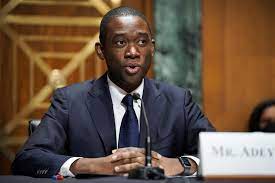
There is no quick and easy solution to Nigeria’s economic challenges, the United States Government has disclosed.
The US Deputy Secretary of Treasury, Wally Adeyemo, who stated this at a forum with business leaders in Lagos, said the country lacks a macroeconomic framework to attract more dollar-denominated foreign direct investments into its economy.
He spoke at the Lagos Business School on the US–Nigeria Economic Relationship.
“There is no quick easy solution to those challenges, I want to be honest about that. That is what true partners are,” Adeyemo told his audience.
“But ultimately, we know that by helping to make investments in Nigeria economy in your businesses, especially, SMEs, we can help build a type of ecosystem that can help Nigeria be successful over time,” he added.
The US Deputy Secretary, who arrived in Nigeria on Sunday, is on a visit to the country as part of the President Joe Biden administration’s commitment to deepening the US – Africa economic and trade relationship.
According to him, while the early steps of the new administration will help the country attract investors, there are still concerns from the investors as regards the repatriation of their funds.
The reforms have been met with mixed reactions, and recently the labour unions in the country embarked on a two-day warning strike.
Stable naira, insecurity
While backing the unification policy in his speech, Adeyemo explained that a stable naira is good for the country and businesses. However, he highlighted that the path to unification will not be easy, but the government must be commended for taking the difficult step.
He said, “Unifying Nigeria’s foreign exchange rates will create the kind of macroeconomic stability that is essential to attracting foreign investment.”
He further stated that Nigeria should be more concerned with FDI that comes from companies that want to invest in its economy and people. He argued that Nigeria’s investment portfolio will increase once it sorts out its macroeconomic framework.
Commenting on the country’s security challenges, the US representative stated, “There are two different security challenges, but we are very invested in working with Nigeria to address them because the insecurity that exists in Nigeria doesn’t exist only within your borders.
“We know that to be the case. That is why America is interested in a strategic and economic partnership with Nigeria. We also want to ensure that we are making investments in communities all over Nigeria to demonstrate to people that there are economic opportunities in their communities that take them away from doing actions that hurt them and their communities.
“Part of this is making sure that we are investing in the security relationship between our two countries, which I know that when Secretary Blinken was here, he had an opportunity to speak to. As you know, or may not know, President Biden had the chance to see the new president on the sidelines of the G20 and talk about the security situations in the region and deepen our relationships.”
Rooting out corruption and the perception of corruption in the business environment is essential for the success of the reforms, Adeyemo pointed out.
There is a legitimate fear that corruption and mismanagement will impact the dividend of these reforms among Nigerians, according to him.
Adeyemo further stressed that Nigeria must prioritise the integrity of its financial system as part of its economic reforms.
He urged, “The cowardly kidnapper, corrupt official, and fraudster all are seeking to launder their money. Taking steps to make your banking system more secure will help reduce the ability of criminals, terrorists, and others to illicitly use the Nigerian financial system.
“I applaud the leadership of the Tinubu Administration in committing to work with the Financial Action Task Force to tackle money laundering and terrorist financing. Our government stands ready to help work through these steps and challenges in financial institution supervision, implementing controls in high-risk sectors, and pursuing investigations and prosecutions.”
The US official added that the 40 million micro, small, and medium-sized businesses in the country, which represent the beating heart of its economy, need government policy to go from being the problem to providing solutions.
On needed reforms to attract foreign investment, Ekpo said, “Definitely, CBN should have some reforms. For example, they should build back their reputation. This will help potential investors to regain confidence in the apex bank. Also, when they constitute the board and the Monetary Policy Committee, it should be more of technocrats than politicians.
“Also, the CBN shouldn’t float the Naira. What they should have is what is called the ‘managed float.’ They should ensure enough supply of the foreign exchange and that can only be done by the CBN working with the fiscal authorities to ensure that the economy becomes productive; where our business people are able to export non-oil goods and services to earn forex.”