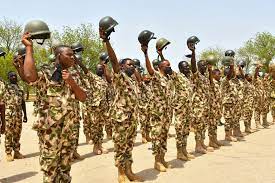
In the light of the escalating coups in Africa, with the West African subregion having the highest, the Federal Government has dismissed any fears of coup in Nigeria, saying the country has gone past a forceful takeover of government.
It stressed that Nigerians had fully embraced democracy and that the country’s democratic institutions were becoming stronger. It said the fact that some African countries, including neighbouring Niger Republic, witnessed coup in recent times did not put Nigeria under any form of fear.
The Minister of Information and National Orientation, Mohammed Idris, said this in an interview with one of our correspondents on Friday, noting, “I can tell you that there is no fear or apprehension at all. We have gone past that, and we have been a democratic country all this while with the institutions of democracy getting stronger.”
Meanwhile, some retired generals in separate interviews with our correspondents warned that the only way to avoid coups on the continent was for elected leaders to respect constitutional provisions and ensure good governance in their respective countries. While not justifying the military takeovers, they said leaders must be accountable and desist from repressive rule if coup must become a thing of the past.
The continent witnessed its latest coup and the second one in 2023 on Wednesday when some military personnel in Gabon seized power and placed the ousted President, Ali Bongo, and his family members under house arrest. Gabon is in Central Africa.
After the forceful takeover, which brought to seven the number of coups on the continent within the past three years, the soldiers announced the annulment of last Saturday’s presidential election that renewed Bongo’s prolonged rule, bringing to an abrupt end the Bongo family’s 56-year rule in the country.
Ali’s father, Omar Bongo, ruled the country from 1967 to 2009, and after his death, his son took over and remained in power until Wednesday.
When asked if there would be any shakeup in Nigeria, the minister said government did not have such plans, adding that Nigeria’s democracy remained stable and peaceful. He added, “That does not even arise. Let’s not talk about what does not even exist at all. Nigeria is stable and peaceful, and all our democratic institutions are very strong and are getting stronger. Like I said, there is no fear or apprehension at all.”
‘Tinubu wants peace’
The minister also emphasised that President Bola Tinubu, who is also the Chairman of ECOWAS, is not interested in any war with Niger.
Many Nigerians had rejected the initial threat by the Tinubu-led ECOWAS that it would consider military action against Niger if it failed to reinstate Bazoum and revert to democratic rule within seven days.
Meanwhile, after persuasion and several peace moves, ECOWAS appears to be considering peace moves, a position adopted by the subregional Committee of Chiefs of Defence Staff.
Tinubu on Thursday proposed a nine-month-transition period to the junta.
The minister however stressed that Tinubu remained committed to peace in Niger.
He said, “The President is interested in the peaceful resolution of this conflict. Of course, he has maintained consistently that there is nothing off the table, but the preference and number one choice for Mr President is that there should be a very peaceful resolution of the conflict there or the return to democratic order.
“The President is a democrat and there is no way he will not support democracy anywhere in the world, particularly on the African continent. So, discussions are ongoing and the fact that something has happened in Gabon does not in any way take away the President’s eyes from the issue in Niger.
“We are not beating the drums of war and war is the last resort for anybody. The President is not interested in war; he is interested in the peaceful resolution of the constitutional disorder there.”
He stressed that consultations were ongoing on the Niger coup.
The minister added, “People are aware that on two occasions, a former Head of State, General Abdulsalami Abubakar, was there and of course, we know that they didn’t really get through because of some reasons for which the military authorities there have explained and apologised.
“They went back there for constructive conversations. You also know that there are efforts by the Council of Ulama that went there two times now. You are also aware that the Nigerian Supreme Council for Islamic Affairs was with the President yesterday to keep appealing for dialogue and calm.”
Ex-generals caution politicians
To halt the resurgence of coups on the continent and avoid it in Nigeria, some retired generals have said the only way out is for democratically elected leaders to respect the constitution and ensure good governance.
“I mean how do you explain the Gabon case where the father spent about 27 years ruling the country and the son came spending another 13 years and he just won a fraudulent third term, tampering with the constitution? The best way is not to give the room for it. I don’t like to discuss the issue of looking up to the international bodies to solve our problems for us. It is a shame that we cannot rule ourselves.”
Kukah reacts
In a related development, the Catholic Bishop of Sokoto Diocese, Matthew Kukah, has also said military intervention was not an option for the country.
Speaking with journalists on the sideline of his 71st birthday celebration, the cleric stated, “I don’t think anybody in this country who is thinking right can contemplate or even make mention of the military; it’s totally out of the question. We have seen the best they can offer us, and we have seen the worst they can offer us.”
He restated that Nigeria remained a great country, adding, “I am confident that if God spares my life, I will see a great Nigeria. I just want to call on Nigerians, let’s be patient with ourselves.”
LP blames impunity
Also speaking, the Chief spokesman for the Obi-Datti Presidential Campaign Council of the Labour Party, Yunusa Tanko, blamed the resurgence on impunity by leaders.
He added, “I am a strong democrat who believes in democracy, but now you can see that democracy is being balkanised and held in high levels of decay and disdain. It is now almost making the people themselves hopeless as regards what they believe in. Those were the things that necessitated these coups around the continent.”
Tanko called on the judiciary to live up to expectations of being the last hope of the oppressed.