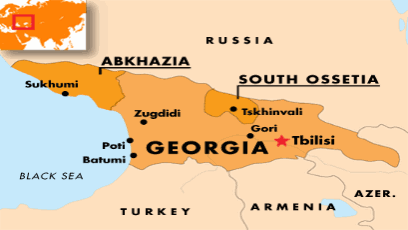
The European Union’s observer mission to Georgia has noticed fewer Russian soldiers in the Russian-controlled regions of South Ossetia and Abkhazia.
“They have also moved a lot of technology out,’’ the head of the mission, Greek diplomat Dimitrios Karabalis.
Nevertheless, 15 years after Georgia and Russia fought a brief war in August 2008, Karabalis saw no movement toward a possible solution to the conflict over the breakaway regions.
About 200 EU observers were currently patrolling the Georgian side of the 390-kilometre-long administrative border with South Ossetia and 150-kilometre-long line with Abkhazia.
The observers, including 23 German police officers, directly faced Russian troops across the dividing line.
Karabalis said he currently does not see any acute danger of open conflict breaking out there.
“They have neither the personnel nor the technology to do anything,’’ Karabalis said.
He added that the same is true on the Georgian side of the conflict as well.
Unlike Azerbaijan, which had spent billions of dollars in oil revenue to take back the disputed Nagorno-Karabakh region in a war against neighbouring Armenia, Georgia lacked resources for a military build-up, Karabalis said.
Nonetheless, tensions can turn to violence at any time, he said.
“We are trying to keep the situation calm here. A small spark can start a big fire.’’
Russia had replaced experienced and trained troops in the breakaway regions of Georgia with inexperienced soldiers and border guards unfamiliar with the situation.
More experienced troops were being sent to fight in Ukraine.
“They don’t know who we are, they are not prepared.
“This is a security risk. For this reason we are distributing leaflets in Russian to explain what we are doing,’’ Karabalis said.