The energy crisis induced by the Russia-Ukraine war has led to a shift to Africa as an alternative source of global energy.
Therefore, it was not surprising that the Africa Union was invited to participate in the recently held G-7 summit in Hiroshima, Japan.
228.1K
So This Happened (204) Reviews Hilda Baci’s Record-breaking Marathon Cooking
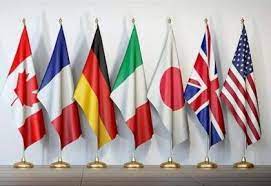
The three-day summit bringing together Heads of State and of Government of the world’s most industrialised nations (including Canada, France, Germany, Italy, Japan, the United Kingdom and the United States plus the European Union) began on Friday, May 19, with an agenda focused on Russia’s aggression against Ukraine, nuclear disarmament and non-proliferation, climate change, development, food security and global health in the wake of the COVID-19 pandemic.
On Friday, Japanese Prime Minister Fumio Kishida opened a meeting with his counterparts from the group of countries. Japan also invited to the event, Comoros President Azali Assoumani in his capacity as the chair of the African Union, as well as Presidents of Brazil, Cook Islands, India, Indonesia, South Korea and Vietnam as well as multilateral and global bodies — including the United Nations, International Monetary Fund and the World Bank. The invitations to leaders outside the G7 are meant to extend cooperation to a broader range of countries. Kishida during the opening session said that the G7 was pursuing unity, not division and confrontation.
Russia’s all-out invasion of Ukraine in 2022 gave the G7 a new sense of purpose after a long period of uncertainty about its role in global affairs. Russia’s attack on Ukraine seems to have led G7 to start coordinating foreign policy with new vigour. Over the last 16 months, G7 leaders and ministers have worked together on several aspects of Russia’s war in Ukraine, from agreeing to a price cap on Russian oil sales to planning reconstruction. In recent months, G7 officials have been consulting one another frequently about the possibility of establishing a tribunal to try Russian leaders for the crime of aggression. Ukraine and its allies in Central and Eastern Europe are not always happy with the G7’s positions, noting that the Group includes a number of powers – France, Germany and Italy – that they believe are too cautious in challenging Moscow.
Nonetheless, G7 members, who have held a series of video conferences with Ukrainian President Volodymyr Zelenskyy since Russia launched its full-scale invasion, see the Group as a useful platform for synchronising policies on the war alongside NATO and the European Union.
According to a report by AP News, in a joint statement issued on Saturday, the G7 leaders reiterated their aim to pull together up to $600bn in financing for projects to develop infrastructure such as railways, clean energy and telecommunications in developing nations.
Countries like Tanzania and the Democratic Republic of the Congo have proven reserves but lack the necessary infrastructure. Others, like Mozambique or Mauritania, also have significant proven reserves and gas export capacity under construction, although they still need to be operational. In this context, the most significant potential lies with established exporters, i.e., countries with available gas export facilities, like Nigeria, Algeria, Egypt, Cameroon, Angola, Equatorial Guinea or the DRC.
Considering the existing infrastructure – pipelines connecting to the European gas network – and recent deals, Algeria, Egypt, Angola and Nigeria are particularly well-positioned to increase exports to Europe and benefit from this momentum.
Speaking with the BBC recently, the African Union’s Trade Commissioner, Albert Muchanga, said Africa would not accept that it “should just continue to be a source of raw materials” for the rest of the world.
Muchanga said instead, his continent wants a future of “genuine and mutually beneficial relationships” with its trade partners.
With Western powers seeking greater trade links with the continent, there have been visits to a host of African countries in the run-up to the summit from the leaders of France and Germany, as well as the US vice president.
Japan’s Prime Minister Fumio Kishida visited Egypt, Ghana, Kenya and Mozambique at the start of this month as he sought to bolster African support for his efforts to counter Chinese and Russian influence on the continent, as well as in regard to Taiwan and Ukraine.
Speaking in Maputo on May 4, he said, “Many countries of the so-called Global South are hurt and suffering from high food and energy prices. The cause of this issue should be traced to Russia’s invasion of Ukraine.”