Nigerians spent about $3bn on foreign healthcare-related services from 2020 to 2022, according to findings by The PUNCH.
The total spending for the period under review was obtained from the Balance of Payments database of the Central Bank of Nigeria.
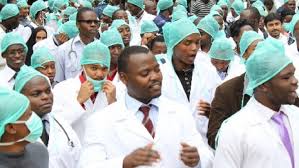
This came to the fore on Tuesday as the Nigerian Association of Resident Doctors insisted on starting a warning strike on Wednesday.
The doctors are starting the strike despite the fact that the Federal Government said it had begun talks with their parent body, the Nigerian Medical Association.
The least bill for medical tourism was in 2016 (about $17m) while the highest amount was spent in 2019 ($2.56bn).
About $783.77m was spent in 2017, while about $1.67bn was spent in 2018.
Since 2019, successive appropriation bills also allocated a total of N24.24bn for the “construction of the presidential wing at the State House Medical Centre.”
The breakdown is as follows: N395.83m (2019), N416.67m (2020), N1.06bn (2021), N21.97bn (2022) and N393.66m (2023).
The State House Medical Centre has been allocated N9.67bn while the Federal Ministry of Health has been allocated about N4.04tn from 2016 to 2023.
In 2016, the Ministry of Health received N250bn, while in 2017, N304.1bn was allocated.
The 2018 budget indicated that the ministry had N356.4bn, while in 2019, N372.7bn went to the ministry.
In 2020, N414.4bn was budgeted for health and the 2021 budget allocated N549.8bn to the Ministry of Health.
The President allocated N1.08tn to the Ministry of Health. Compared to the previous year, the health sector budget increased from 714bn. However, the N1.08tn only accounts for 4.93 per cent of the total budget. This is significantly less than the benchmark of the World Health Organization to allocate at least 15 per cent of the annual national budget to health.
The standard of healthcare in the country has been questioned over the years citing underfunding as a major factor, causing several Nigerian doctors to migrate to other developed countries.
A bill seeking to prescribe a jail term of seven years and, or a fine of N500m narrowly passed second reading at the House of Representatives in February last year.
Sponsored by Sergius Ogun (Peoples Democratic Party/Edo), the legislation is titled ‘A Bill for an Act to Amend the National Health Act, 2014; and for Related Matters.’
Leading the debate on the bill, Ogun noted that the objective of the proposal was to amend the Act “so as to make provision for sanctions against any public officer who violates the provisions of the Act, especially Section 46 of the Act.
The section reads, ‘Without prejudice to the right of any Nigerian to seek check-up, investigation or treatment anywhere within and outside Nigeria, no public officer of the Government of the Federation or any part thereof shall be sponsored for a check-up, investigation or treatment abroad at public expense except in exceptional cases on the recommendation and referral by the medical board and which recommendation and referral shall be duly approved by the Minister or Commissioner of Health of the state as the case may be.’
Ogun said, “This bill, which seeks to amend the National Health Act, is borne out of a desire to discourage medical treatment abroad at the detriment of our indigenous health institutions. The need to revamp the poor state of the healthcare sector in Nigeria, among other things, is the reason for introducing this bill.
“It is no news that Nigeria’s health care system is in a deplorable state and needs urgent attention. There is a paucity of infrastructure, a dearth of medical personnel, poor standards and many other challenges that need to be addressed. The intent of this bill is to spur public officers to pay more attention to our health care sector and take drastic steps to develop and improve on the sector.”
“The government needs to sit up; the government must address the issue of doctors’ migration. Whatever remuneration is needed, we have to act like serious people and ensure that we sustain essential services and appreciate our doctors.
“We need to improve infrastructure in the health sector. We need to have the needed infrastructure and there should be the full implementation of the National Health Act that was promulgated in 2014. The budgetary allocation for health must be increased to at least 15 per cent.”
Adesola further urged the president to lead by example and stay back for medical treatment in Nigerian hospitals.
A former President of the Nigerian Medical Association, Prof Mike Ogirima, on his part criticised any government official spending public funds on medical tourism.
He described this act as corruption, noting that Nigeria has enough competent hands.
Ogirima said, “The factors aiding medical tourism range from personal desire and the ability to foot the bill, but I’d course, there is corruption there because for government officials spending public funds for medical tourism is part of the corruption we are saying.
“Gone are the days when non-availability of qualified hands to handle medical issues; we have qualified hands now, and we are handling them now. Apart from them, our doctors who travel out of the country as a result of brain drain are coming back to offer skilful services to complement the ones trained locally. Those of us that are here have also improved our capacity by updating our skills.”
He added that investments in the sector remain the only solution to curb the menace adding that politicians can only be appealed to in order to reduce the amount of forex spent on medical tourism.
He said, “There are some top-notch facilities in the country that does not require travelling abroad or sourcing for forex. But our politicians are bent on travelling because it is not their funds, which is quite unfortunate.
“There are many people who have serious health challenges and are surviving from treatment received here, but since there are no laws that compel them to have their treatment here so we can only appeal to fund the health sector well so that we can save our forex.”
“There is also a need to increase the budget for the health sector locally and make sure the sector is vibrant,” he added.
Meanwhile, about 12,000 members of the NARD across 79 tertiary health institutions in the country, who formed the backbone of the healthcare sector, will commence a five-day warning strike at 8 am today (Wednesday).
NARD said the warning strike would end on Monday, May 22.
The resident doctors had, on April 29, 2023, issued a two-week ultimatum to the Federal Government to meet their demands or face industrial disharmony.
But speaking in an interview with The PUNCH on Tuesday, the President of NARD, Dr Emeka Orji, said, “What we are asking for is not for the doctors but for the health system in general, because if we do not address these issues, the problems we are having in the sector will continue to happen and it will get to a time when there will be a total collapse of the system.
“Doctors are leaving in droves, clinical staff are leaving and we have always said that the most important cause of the brain drain in the sector is poor remuneration. We have even done a study on this, and we have said this over and over again. If we do not address these issues, it will come to a point when we will not even have nurses to attend to patients.
“Politicians and associates who are well-to-do will leave us here and go out to seek health care services outside of the country, the poor masses on the street cannot afford to do that. What we are doing is to call the attention of the government to act and request that they address the issues so that they can stay in the country to serve the country.”
Asked if the NMA and the Medical and Dental Consultants Association of Nigeria were in support of the NARD strike, Orji said, “We do not have official evidence that they are against the strike. The government should wade in and solve what they can solve and give timelines for the ones they are yet to do but, there has not been anything from them.
“We have a President-elect, we know that he is watching, and people are watching. It may not be good for them to take over when there is a crisis in the health sector, and that was why we have to restrain our people to continue to exercise patience.”
Orji called on the government to address the issues raised before the May 29 handover date as further industrial harmony could not be guaranteed after the warning strike, should the issues be left unresolved.
“All options are on the table when we meet, including indefinite strike action… after the warning strike should the issues be left unresolved,” he said.