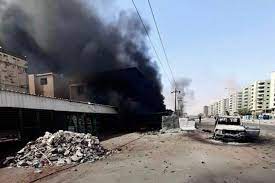
Sudanese fighter jets pounded paramilitaries in Khartoum on Thursday while deadly fighting and looting flared in Darfur, as the army and a rival force agreed to extend an existing ceasefire even as battles raged.
In the final hours of a repeatedly broken three-day ceasefire, due to end at midnight (2200 GMT), the army and the Rapid Support Forces announced a 72-hour extension following pressure from Saudi Arabia and the United States.
There have been multiple truce efforts since fighting broke out on April 15 between Sudan’s army led by General Abdel Fattah al-Burhan and the paramilitary RSF commanded by his deputy turned rival, Mohamed Hamdan Daglo. All have failed.
US Secretary of State Antony Blinken said the ceasefire had been “imperfect”, but “nonetheless has reduced violence”.
“I hear intense shelling outside my home,” a Khartoum resident told AFP on Thursday evening, asking not to be named.
On Thursday, warplanes patrolled over the capital’s northern suburbs as fighters on the ground exchanged artillery and heavy machinegun fire, witnesses said.
At least 512 people have been killed and 4,193 wounded in the fighting, according to health ministry figures, although the real death toll is likely much higher.
Canada said on Thursday it had completed its first military flight carrying evacuees, with Defence Minister Anita Anand calling the situation “very volatile”.
As lawlessness has gripped Sudan, there have been several jailbreaks, including from the high security Kober prison where top aides of ousted dictator Omar al-Bashir were held.
Among the escapees is Ahmed Harun, wanted by the International Criminal Court to face charges of war crimes and crimes against humanity in Darfur.
Harun’s escape sparked fears of the involvement of Bashir loyalists in the ongoing fighting.
The army said 79-year-old Bashir was in a military hospital, and was moved before the fighting erupted.
Daglo’s RSF emerged from the Janjaweed militia, accused of carrying out atrocities during Bashir’s brutal suppression of ethnic minority rebels in Darfur in the mid-2000s.
Bashir was toppled by the military in April 2019 following civilian mass protests that raised hopes for a transition to democracy.