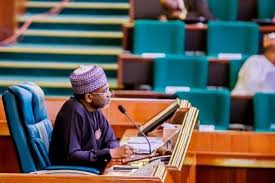
Top officials of the Federal Government failed to appear before the House of Representatives in the ongoing investigation of the alleged illegal sale of 48 million barrels of crude oil valued at $2.4bn.
The House’ Ad Hoc Committee to Investigate Alleged Loss of Over $2.4 Billion in Revenue from Illegal Sale of 48 Million Barrels of Crude Oil Export in 2015 Including All Crude Oil Exports and Sales by Nigeria from 2014 Till Date commenced its three-day investigative hearing on Tuesday.
The committee was to grill ministers and other heads of ministries, departments and agencies of the Federal Government as well as oil companies and banks.
However, only the National Intelligence Agency sent a representative on the government side.
Consequently, the committee summoned the Minister of Finance, Budget and National Planning, Zainab Ahmed; Minister of Justice and Attorney-General of the Federation, Abubakar Malami (SAN); Secretary to the Government of the Federation, Boss Mustapha, among others.
Chairman of the committee, Mark Gbillah, in his ruling at the end of the day’s sitting, noted that the Central Bank of Nigeria and the Office of the Accountant-General of the Federation had indicted several officials and agencies in their memoranda to the panel.
Gbillah noted that the committee is probing into the 48 million barrels of crude oil allegedly sold in China, crude oil exports in general from Nigeria for the period under review and the whistle-blower revelations and recoveries “which the Federal Government has publicly declared they had made recoveries from.”
The Speaker added that Nigeria’s revenue to Gross Domestic Products ratio is below 5 per cent, which is rated amongst the five lowest countries in the world, “and it is reported that about $700m worth of crude oil is lost to oil theft monthly in Nigeria.”
He said, “In January and July 2022 alone, Nigeria lost $10bn to the crime. Available data shows that the country may lose $23bn this year to crude oil theft, with concerns being expressed about the possibility of meeting 2023 proposed production target of 1.69 million barrels per day due to the myriad of issues militating against the attainment of this target, such vandalism, in-accurate reconciliation, insecurity and unreasonable operational cost.
“In the light of dwindling revenue accruing to Nigeria from crude oil sales, it was quite alarming to learn about whistle-blower allegations that over $2.4bn in possible revenue by the country was lost from the sale of 48 million barrels of Nigeria’s crude oil cargoes in China.
“While it is imperative to highlight that these are unverified allegations, the onus is on the House of Representatives, as a responsible House of the Nigerian people, to carry out a thorough investigation to ascertain the veracity or otherwise of these allegations, including an investigation into crude oil exports from Nigeria from 2014 to 2022, to ascertain the accuracy of recorded revenue from sales during this period, the utilisation of this revenue and identify any likely additional losses in revenue to the country.”
Gbajabiamila stated the probe was not a witch-hunt exercise but a constitutional responsibility within the legislative powers of the House as enshrined in Sections 88 and 89 of the 1999 Constitution, Section 2 of the Legislative Houses (Powers and Privileges) Act, 2017, and the Standing Orders of the House of Representatives.
The Speaker further said, “Corruption continues to be the bane of Nigeria’s development, with Nigeria ranking 150th out of 180 countries in the most recent Transparency International’s Corruption Perceptions Index. While the government, through its anti-graft agencies, continues the onerous fight against corruption, the task remains daunting and requires the cooperation of all Nigerians to curb and eventually eradicate.
“It is the practice globally for individuals with information about the existence of proceeds from illegal or corrupt actions by government officials or private individuals to volunteer such information and receive compensation when recoveries are made as an incentive to others.
“While it is commendable that this administration introduced a whistleblower policy in 2016 and has confirmed recovery of significant proceeds of corruption from its implementation, the policy is without statutory backing and the receipt and expenditure of these proceeds does appear to conform to constitutional provisions and the payment of compensation does not appear to be transparent.”
Gbajabiamila pointed out that the recommendation of the committee, after its investigation, would no doubt guide the House in making an informed decision in considering the Whistle-Blower Bill currently before it.
“The legislation, when passed into law, will address a mirage of issues associated with the implementation of the policy as well as take adequate care of the whistle-blowers involved, which is very significant in the success of the policy and law when passed,” he added.