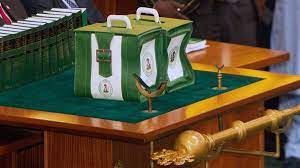
The President, Muhammadu Buhari on Friday, laid the 2023 Appropriation Bill before a joint session of the National Assembly. The bill was tagged, ‘Budget of Fiscal Sustainability and Transition.’
However, the key provisions in the proposed N20.51tn budget have attracted reactions from major stakeholders, including the Nigerian Association of Chambers of Commerce, Industry, Mines and Agriculture, Lagos Chamber of Commerce and Industry, economists and lawmakers, among others.
Planned expenditure
Of the N20.51tn budget, statutory transfers amount to N744.11bn; non-debt recurrent costs, N8.27tn; personnel costs, N4.99tn; pensions, gratuities and retirees’ benefits, N854.8bn; overheads, N1.11tn; capital expenditure, N5.35tn, including the capital component of statutory transfers; debt service, N6.31tn; and sinking fund of N247.73bn to retire certain maturing bonds.
In his presentation, Buhari said, “We expect total fiscal operations of the Federal Government to result in a deficit of N10.78tn. This represents 4.78 per cent of estimated GDP, above the three per cent threshold set by the Fiscal Responsibility Act 2007. As envisaged by the law, we need to exceed this threshold considering the need to continue to tackle the existential security challenges facing the country.
“We plan to finance the deficit mainly by new borrowings totalling N8.80tn: N206.18bn from privatisation proceeds and N1.77tn draw-downs on bilateral/multilateral loans secured for specific development projects/programmes.”
NASS committees’ illegality
Buhari also slammed committees of the National Assembly for allegedly bypassing him and approving budgets for government-owned enterprises without his approval.
He said, “Distinguished Senators, honourable members, you may recall that we earlier integrated the budget of government-owned enterprises into the FGN’s 2019 budget submission. This has helped to enhance the comprehensiveness and transparency of the FGN budget. It has, however, come to my attention that government-owned enterprises liaise directly with relevant NASS committees to have their budget passed and issued to them directly.
“I would like to implore the leadership of the National Assembly to ensure that the budget I lay here today, which includes those of the GOEs, be returned to the Presidency when passed. The current practice where some committees of the National Assembly purport to pass budgets for the GOEs, which are at variance with the budgets sanctioned by me, and communicate such directly to the MDAs, is against the rules and needs to stop.”
He added that current efforts to properly equip and motivate the nation’s valiant personnel in the armed forces, the police and paramilitary units would be sustained.
“I assure you, insecurity, especially banditry and kidnapping, will be significantly curtailed before the end of this administration. We will redouble our efforts to ensure we leave a legacy of a peaceful, prosperous and secured nation,” he stated.
Discrepancies shock lawmakers
Members of the National Assembly, however, expressed shock over the irregularities between the estimates presented by the President and those contained in the 2023-2025 Medium Term Expenditure Framework and Fiscal Strategy Paper passed by the Senate and the House of Representatives during the week.
The Chairman of the House Committee on Media and Public Affairs, Benjamin Kalu, said the lawmakers only learnt about the major changes from the President while he was addressing the parliament.
In the MTEF/FSP, the Assembly had approved an aggregate Federal Government expenditure of N19.76tn made up of total recurrent (non-debt) of N8.53tn; personnel costs (MDAs) of N827.8bn; capital expenditure (exclusive of transfers), N3.96tn; special intervention (recurrent), N350bn; and special intervention (capital) of N7bn.
Also approved were crude oil production of 1.69 million barrels per day, 1.83mbpd and 1.83mbpd for 2023, 2024 and 2025, respectively; oil benchmark of $73 per barrel; and exchange rate of N437.57 to the United States dollar.
The lawmakers had also approved a projected Gross Domestic Products growth rate of 3.75 per cent and an inflation rate of 17.16 per cent.
They also passed N8.437tn for foreign and domestic borrowing; a fiscal deficit of N10.563tn, including GOEs; statutory transfers totalling N722.11bn; debt service estimate of N6.31tn; Sinking Fund to the tune of N247.7bn; as well as pension, gratuities and retirees’ benefits of N827.8bn.
While the Executive proposed N3.6tn for the payment of subsidy on Premium Motor Spirit, popularly known as petrol, till June 2023, the lawmakers had approved N1.7tn.
“I will go against a government that will borrow and leave debt for the incoming administration or the country to inherit. If you borrow on a very healthy threshold, there is nothing wrong with it,” she said.
The Chairman of the Senate Committee on Appropriations, Senator Jibrin Barau, said, “He (Buhari) brought it (the budget) in a box. We will now go and unveil it and look at the proposal and analyse what is in there before we begin to respond to anything.”
Barau, however, said no government since the inception of the current democratic dispensation in 1999 had done as much as the Buhari regime.
“All we need to do is to continue from where the government stops next year. It is a long journey. Before you experience economic buoyancy, an enabling environment and infrastructure is one of the fundamentals needed,” he added.
Senator Kabiru Gaya also said the Senate would discuss the budget next week and hoped that the National Assembly would pass the bill before the end of November or early December.
The Deputy President, Lagos Chamber of Commerce and Industry, Gabriel Idahosa, criticised the Federal Government’s decision to retain fuel subsidy in the 2023 budget.
According to him, the government is staring down another difficult race with regard to financing a budget that is far above its expected revenue.
He said, “Fuel subsidy should have ended by January this year. That is, in the budget of this year, fuel subsidy should have been removed.
“We don’t have the money to finance this budget. For this year, we have not been able to raise half of what we have spent.”
On the N1tn allocated to the Police Service Commission, Idahosa said it was grossly insufficient and would imply an understaffed police force incapable of addressing the nation’s mounting security crisis.
‘Budget mere ritual’
Professors of Economics and financial experts said the 2023 proposed budget was bound to flop.
According to them, the government’s plan to fund it from borrowing is absurd and will worsen the country’s debt burden.
An economist and former Vice-Chancellor, University of Uyo, Prof Akpan Ekpo, said it was dangerous for the country to hope to fund the over N20tn budget through borrowing.
Ekpo stated, “The debts keep increasing and the amount of money used to service debts is also quite high. I can recollect that about 70 per cent or so is being used in servicing debts for 2022. That is worrisome. If the government keeps borrowing to fund recurrent expenditure, it is not good for the economy. It will retard growth.
“The truth is that this budget for them is just an empty ritual and it doesn’t excite me.”
The Managing Director/Chief Executive Officer, Taurus Capital, Mr Nnaemeka Obiaraeri, noted that the proposed budget was one of “poverty perpetration and collective elitist grandstanding and looting.”
According to him, it makes no sense for the government to propose N20.5tn over the N13tn proposed in the last budget without a commensurate growth in revenue.
CPPE x-rays budget
The Chief Executive, Centre for the Promotion of Private Enterprises, Dr Muda Yusuf, told one of our correspondents that the budget had further showed a troubling fiscal outlook for Nigeria.
‘Naira badly devalued’
Commenting on the 2023 budget, a former President of the Association of National Accountants of Nigeria, Dr Sam Nzekwe, stated that the N20.51tn appropriation was not high, rather it showed how bad the naira had been devalued.
Nzekwe stated that the projected N8.8tn to be borrowed to fund the budget deficit was too high and wondered when the government would start cutting down on its excessive borrowings.
Nzekwe stated, “I don’t look at the N20.51tn as an increase in budget, because if you consider the devaluation of the naira, you will realise that it has lost value significantly. Last year, the exchange rate was not as high as it is now. It is now over N700/$ at the parallel market.
“So, I don’t look at it as an improvement over the other budgets, but I see it from the view that it is this high because of the devaluation of the naira. The naira today is badly devalued and is far below what it was yesterday.