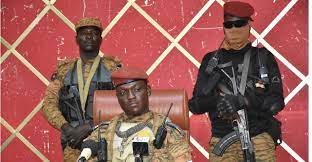
Just a week ago, 34-year-old Ibrahim Traore was unknown, even in his native Burkina Faso.
But in the space of a weekend, he catapulted himself from army captain to the world’s youngest leader – an ascent that has stoked hopes but also fears for a poor and chronically troubled country.
Traore, at the head of a core of disgruntled junior officers, ousted Lieutenant-Colonel Paul-Henri Sandaogo Damiba, who had seized power just in January.
The motive for the latest coup – as in January – was anger at failures to stem a seven-year jihadist insurgency that has claimed thousands of lives and driven nearly two million people from their homes.
On Wednesday, Traore was declared president and “guarantor of national independence, territorial integrity… and continuity of the State.”
At that lofty moment, Traore became the world’s youngest leader, wresting the title from Chilean President Gabriel Boric, a whole two years older.
Traore’s previously unknown face is now plastered on portraits around the capital Ouagadougou.
His photo is even on sale in the main market, alongside portraits of Burkina’s revered assassinated radical leader, Thomas Sankara, and of Jesus.
– Military career –
Traore was born in Bondokuy, in western Burkina Faso, and studied geology in Ouagadougou before joining the army in 2010.
But it was a move that ironically would sow the seeds of Damiba’s own downfall.
The regiment became a cradle of discontent, and Traore, tasked by his colleagues with channelling their frustrations, made several trips to Ouagadougou to plead their case with Damiba.
Disillusionment at the response turned into anger, which appears to have crystallised into resolve to seize power after an attack on a convoy in northern Burkina last month that left 27 soldiers and 10 civilians dead.
“Captain Traore symbolises the exasperation of junior officers and the rank and file,” said security consultant Mahamoudou Savadogo.
The new president faces a daunting task in regaining the upper hand over jihadist groups, some affiliated with Al-Qaeda and others with the Islamic State. They have steadily gained ground since they launched their attacks from Mali in 2015.